
Hire in Serbia
This is your starting point for delving into human resources best practices and the hiring process in Serbia.

Serbian Currency
Serbian Dinar (RSD)

The Capital of Serbia
Belgrade
Time Zone in Serbia
GMT+1
Important Facts About the Country of Serbia
Introduction to Serbia
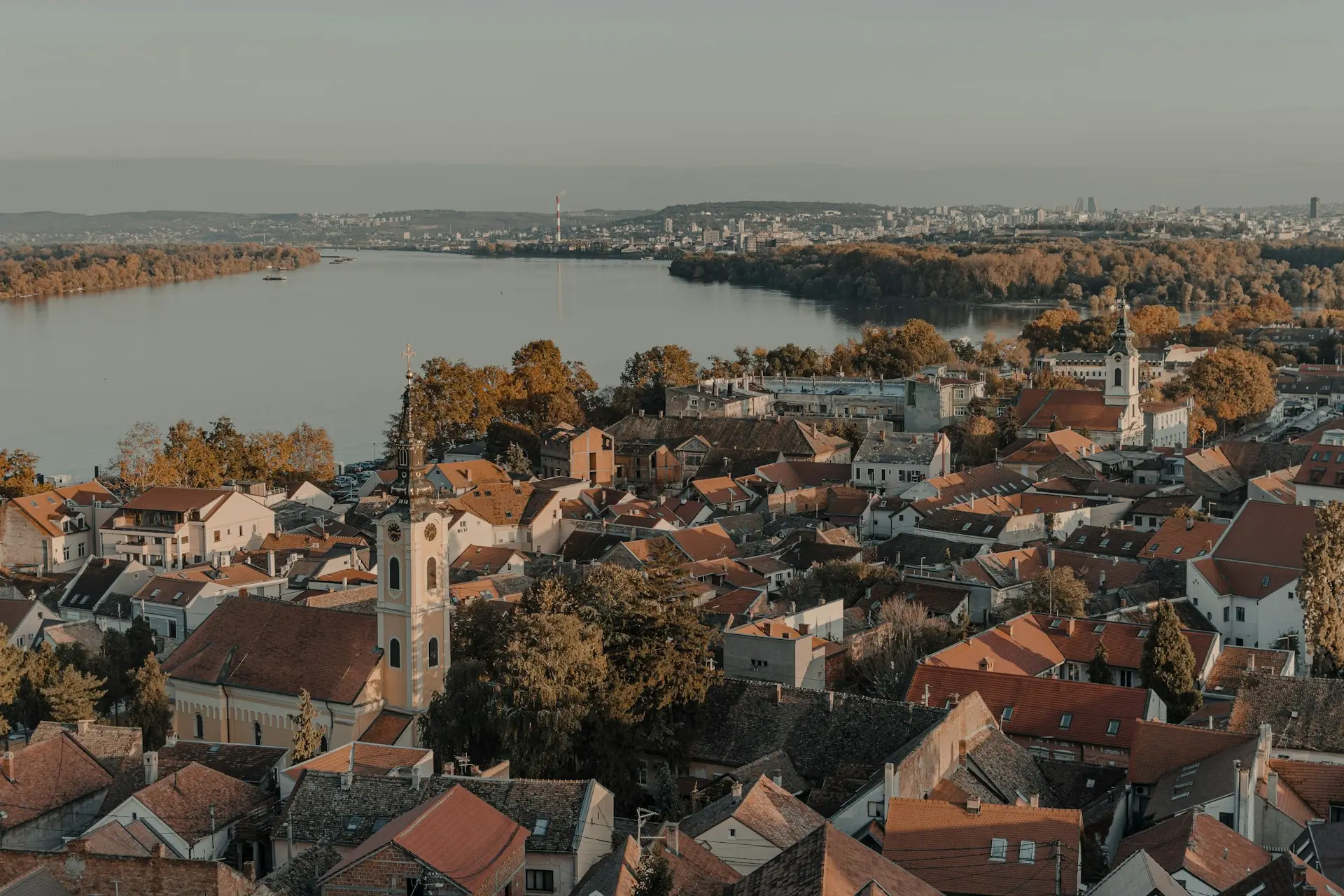
Serbia, officially known as the Republic of Serbia, is a landlocked nation situated in Southeastern and Central Europe. The population stands at 6.7 million people (excluding Kosovo; 8.4 million including Kosovo). Despite Kosovo’s declaration of independence in 2008, Serbia rejects this claim, considering Kosovo an autonomous province. The capital and largest city is Belgrade. Serbia boasts an upper-middle-class economy, providing citizens with free primary and secondary education, along with healthcare services.
What to Know about Serbia’s Geography
Situated on the Balkan peninsula and within the Pannonian Plain, Serbia spans an area of 88,499 square kilometers (including Kosovo). It shares land borders with Hungary to the north, Romania to the northeast, Bulgaria to the southeast, North Macedonia to the south, Croatia and Bosnia and Herzegovina to the west, and Montenegro to the southwest. Additionally, there is a disputed border with Albania through Kosovo. The central region features mostly hilly terrain sculpted by rivers, while the southern third of Serbia is predominantly mountainous.
Climate in Serbia
In the northern regions of Serbia, a continental climate prevails, characterized by chilly, arid winters and warm, humid summers featuring evenly distributed rainfall. Meanwhile, in the southern areas, a more Mediterranean climate is observed, bringing hot, dry summers and autumns, along with mild, rainy winters.
The Culture of Serbia
Throughout centuries, Serbia’s territory underwent various divisions, initially between the eastern and western sectors of the Roman Empire and later between the Byzantine Empire and the Kingdom of Hungary. During the early modern era, the land was partitioned between the Ottoman Empire and the Habsburg Empire. This historical process has led to distinct cultural influences in different parts of Serbia. The northern regions exhibit similarities to Central Europe, while the southern areas reflect the cultural traits of the Balkans and the Mediterranean.
Religions Observed in Serbia
Serbia, as a secular state, upholds religious freedom as enshrined in its constitution. The majority of the population, approximately 84.5%, adheres to Orthodox Christianity. The Serbian Orthodox Church, predominantly followed by Serbs, stands as the largest and most traditional religious institution in the country.
Languages Spoken in Serbia
Serbian is the official language, spoken natively by 88% of the population. English holds the position of the most widely spoken and studied foreign language in Serbia, with a significant proficiency level, particularly among the younger generations.
Serbian Human Resources at a Glance
Employment Law Protections in Serbia
The Labor Law (2005) serves as the primary legal framework governing the rights, obligations, and duties arising from labor relationships. It is paramount, establishing a baseline that cannot be undercut by collective agreements, labor rulebooks, or employment contracts. Additional sources of employment law encompass a diverse range of statutes such as the Health and Safety at Work Act, the Act on Prevention of Harassment at Work, the Employment and Unemployment Insurance Act, the Health Protection Act, the Pension and Disability Insurance Act, the Strike Act, the Anti-Discrimination Act, the Labor Records Act, the Vocational Rehabilitation and Employment of Persons with Disabilities Act, the Employment of Foreign Nationals Act, and more.
Employment Contracts in Serbia
To initiate employment, a formal agreement between the employer and the employee must be executed. These employment contracts must be documented in Serbian, though the option for dual-language contracts, featuring both Serbian and another language, is admissible.
Prior to commencing work, the employee is obligated to sign a written contract incorporating the following details:
Details encompassed in the employment contract are as follows:
- Name and registered office of the employer.
- First name, family name, and place of residence of the employee.
- Qualifications or education level required for the job.
- Job title and comprehensive job description.
- Work location.
- Nature of employment (indefinite or definite term).
- Duration of a fixed-term employment contract, along with the rationale for such an arrangement.
- Commencement date of employment.
- Working hours specification (full-time, part-time, or reduced).
- Compensation particulars, including:
- The monetary value of the basic salary at the contract initiation.
- Factors influencing basic salary (e.g., performance metrics).
- Other sources of income for the employee.
- Timelines for remitting the employee’s salary and additional entitlements.
- Reference to the prevailing collective agreement or labor rulebook.
- Daily and weekly working hour duration.
The employment contract may additionally enumerate various rights and obligations.
In the event that the employee fails to report to work on the stipulated day as per the contract, an employment relationship does not materialize, unless the employee had a valid reason for being unable to commence the job or if such an arrangement was mutually agreed upon by the employer and employee.
Serbia's Contract Terms
The duration of an employment contract can either be definite or indefinite. In cases where the timeframe is not explicitly stated, the contract is considered indefinite.
If a fixed-term contract concludes, and the employee continues working for five or more consecutive working days, it automatically transforms into an indefinite contract.
Pre-Employment Checks
A job applicant is required to present documents and evidence to the employer demonstrating their qualifications for the position. According to the law, an employer is prohibited from inquiring about a job applicant’s family, marital status, family planning intentions, or any information unrelated to the job.
The current Serbian data protection law, effective since August 2019 and largely aligned with the EU General Data Protection Regulation, prohibits employers from requesting a certificate of criminal history from candidates. In general, employers can review publicly accessible information about candidates, including information available on public social media profiles. However, it is mandatory for the employer to notify the candidate before collecting and processing any information, even if it is publicly available.
Serbia's Guidelines Regarding Probation Period
When initiating a new employment arrangement, the employer has the option to establish a probationary period with the employee. This probationary duration may extend for a maximum of six months. Within this trial period, either party, be it the employer or the employee, possesses the authority to terminate the contract, provided a minimum notice period of five days is given.
Regulations and Rules Regarding Working Hours in Serbia
A full-time employee is limited to working up to 40 hours per week. Typically, there are five working days in a week, and the employer has the discretion to determine the distribution of these hours. Generally, a standard workday consists of eight hours.
Full-time workers are entitled to a daily break of at least 30 minutes, and this break is considered a part of their regular work hours.
Serbian Laws Regarding Overtime
According to the law, employees may work overtime at the employer’s request in the following cases:
- In the occurrence of force majeure;
- In the case of an abrupt expansion in the scope of work; and
- When there is a need to complete the work by a specified deadline.
Overtime is capped at four hours per day or eight hours per week. When an employee exceeds regular working hours, compensation is provided at a rate of at least 126% of the base salary.
Health and Safety in the Workplace
Employers must furnish employees with comprehensive training on health and safety regulations, a prerequisite before commencing work. This proactive measure ensures that workers possess the essential qualifications and skills to perform their duties safely, mitigating the risk of workplace accidents or injuries. The training encompasses imparting sufficient knowledge about the relevant health and safety regulations and workplace rules.
Rules Regarding Bonus and 13th Month Pay in Serbia
Payout of bonuses is discretionary, and employers are not obligated to provide them. The taxation of bonuses mirrors the taxation structure applied to salaries.
Serbia's Requirements Regarding Notice Periods
For voluntary resignations, employees are required to submit written notice at least 15 days prior to the effective date, with the stipulation not exceeding 30 days.
When an employer terminates an employee without specific cause, the notice period is contingent on the grounds for termination.
- In instances where an employee is terminated due to performance deficiencies or a lack of requisite knowledge and skills, the mandated notice period ranges from one to three months, depending on the duration of the employee’s contribution to social insurance.
- In cases of unilateral termination, such as breaches of work duties or rules, or redundancy, there is no prescribed notice period unless otherwise stated in the employment contract.
During the probationary period, both the employer and the employee are required to provide a minimum of five working days’ notice if either party intends to terminate the employment relationship.
Termination
When an employer terminates an employee without just cause, the procedural steps will be contingent upon the grounds for termination. The employer has the authority to terminate the employment contract based on reasons outlined in the Labor Law, encompassing the following situations:
- Reasons related to the employee’s work ability and conduct (e.g., failure to achieve work results or lacking necessary knowledge and skills for duties).
- Breach of work duty by the employee (e.g., negligence or recklessness in performing duties).
- Non-compliance with work discipline requirements (e.g., refusal to perform work or execute employer’s orders).
- Changes in the employer’s needs (e.g., technological, economic, or organizational changes leading to the cessation of a specific job) or a decrease in workload (redundancy).
Notice Period: If termination is based on the employee’s failure to achieve specific work results, the employer must adhere to notice period requirements, ranging from eight to 30 days. The specific duration is determined by work rules or the individual employment agreement, contingent on the length of social insurance coverage. Other legal grounds for termination do not mandate specific notice periods.
Payments: Upon termination of the employment relationship, the employer must settle all outstanding salary and earnings, including compensation for unused annual vacation, within 30 days. Severance payment is obligatory only in cases of termination or retirement.
Employee Protection: Termination is prohibited when employees are
- pregnant,
- on maternity leave,
- on childcare leave, or
- on special childcare leave.
Restrictive Covenants
The employer has the ability to contractually limit the employee’s utilization of confidential information post-employment termination. The Serbian law on business secrets safeguards a company’s confidential information for the duration that the pertinent data remains undisclosed.
Redundancy/Severance Pay in Serbia
Employers are obligated to provide severance payments to all employees affected by redundancy, regardless of whether it results from a collective or individual decision.
The specific amount of the redundancy severance payment is typically determined by the employer or outlined in the employment contract. However, there exists a legal minimum requirement equivalent to one-third of the employee’s monthly salary for each complete year of service with the current employer (including its affiliates and predecessors). The calculation is based on the average monthly salary the employee received in the three months preceding the redundancy.
The Labor Law guarantees that the minimum severance pay is exempt from taxation.
Fixed Term Contacts for Serbian Employees
Fixed-term employment contracts can endure for a maximum of 24 months, with or without intervals. These contracts are permissible in various scenarios, such as seasonal employment, project-based tasks, and increased workloads slated for a specific duration.
Extensions of fixed-term contracts can occur under the following circumstances:
- Substituting for a temporarily absent employee until their return.
- Engaging in project work with a predetermined duration until project completion.
- In the case of a foreign national holding a work permit, the term extends until the permit expiration.
- For newly established businesses (e.g., registered with the business registry within the last 12 months), the term can be extended up to 36 months.
- If the employee is an unemployed individual with less than five years left until meeting retirement conditions.
Employees under fixed-term contracts enjoy the same rights and responsibilities as those under indefinite-term contracts.
Data Protection
Serbian law does not have explicit regulations regarding workplace monitoring. The rules on data protection within the Law on Personal Data Protection (LPDP) are applicable to such monitoring practices and define the legal boundaries.
For employee monitoring to be lawful, it is imperative to inform employees in advance about the intended utilization of their personal information. Furthermore, a valid legal justification must exist for this purpose.
Tax and Social Security Information for Employers in Serbia
Personal Income Tax in Serbia
A flat rate of 10% is applied to an employee’s gross employment income for Personal Income Tax. Nevertheless, the basis for income tax on employment income is decreased by a monthly non-taxable personal allowance of RSD 21,712 for full-time employees (effective from 1 January 2023).
Employers are responsible for computing employees’ income taxes, deducting these amounts from salary payments, and remitting the payments to tax authorities on behalf of the employees.
Social Security in Serbia
Social security contributions are determined according to the employee’s gross salary. The minimum income threshold is set at 35% of the average monthly salary in Serbia for the 12 months leading up to September of the current year, with the maximum limit being RSD 500,360.
Both the employer and the employee contribute to social security, except for unemployment insurance, which is solely the responsibility of the employee. The contribution rates are as follows:
| EE (%) | ER (%) | Total (%) | Monthly Cap (RSD) | |
|---|---|---|---|---|
| Pension and disability insurance | 14 | 10 | 24 | 500,360 |
| Health insurance | 5.15 | 5.15 | 10.3 | |
| Unemployment insurance | 0.75 | 0 | 0.75 |
Similar to income tax, the combined social security contributions (comprising both employer and employee contributions) are computed, deducted from the salary, and remitted by the employer.
*The provided rates are general indications; the actual rates applied may vary.
Important Information for Serbian Employees
Salary Payment
Compensation is disbursed retrospectively on or before the 15th day of the subsequent month.
Payslip
The employer is required to distribute payslips containing the salary breakdown for the preceding month before the month concludes. Additionally, the employer is obligated to maintain a record of monthly salary and compensation.
Timesheets & Record Keeping
Employers must maintain daily records of their employees’ overtime hours, which should be accessible for scrutiny during labor inspection visits.
Additionally, mandatory salary records documenting the employee’s anticipated working hours, the actual hours worked, and both compensated and uncompensated non-performed hours must be retained permanently.
Annual Leave
In Serbia, employees are entitled to a minimum annual leave of 20 working days per calendar year. The duration of annual leave can be extended based on factors such as work performance, work conditions, work experience, educational level, and other criteria specified in the employment contract.
Employees accrue one-twelfth of their annual leave entitlement for each month worked in the calendar year.
Annual leave can be taken either in a continuous period or split into two shorter periods. If taken in parts, the initial segment should be no less than three working weeks within a calendar year, and the second part should conclude no later than June 30th of the following year.
Employees unable to utilize their annual leave in the current calendar year (e.g., due to maternity or childcare leave) have the right to carry it over to the following year, expiring before June 30.
During annual leave, employees are entitled to compensation equivalent to their average salary in the preceding 12 months.
Employers are obligated to notify their employees 15 days prior to the commencement of annual leave.
Upon termination, the employer must furnish the employee with a certificate detailing the number of annual leave days utilized.
Public Holidays
There are 10 nationally recognized public holidays, and employees may also be entitled to time off on specific religious holidays, contingent upon their religion and the relevant religious calendar.
If a public holiday falls on a Sunday, the subsequent working day is considered a non-working day. During public holidays, employees have the right to paid leave, calculated based on their average salary from the preceding 12 months.
Sick Leave
Employees are generally eligible for sick pay whenever they are unwell or injured, without any specific restrictions. An employee is mandated to submit a medical certificate issued by a physician, certifying their temporary inability to work, no later than three days from the onset of the incapacity. The certificate should also specify the anticipated duration of the sick leave. For the initial 30 days of sick leave, the employee receives sick pay as follows:
- 65% of their average salary from the preceding 12 months for non-work-related sickness or injury
- 100% of their average salary from the preceding 12 months for work-related sickness or injury
During the initial 30 days of sick leave, the employer covers the sick pay. After this period, the employer continues to provide sick pay, but it becomes recoverable from the state.
There are no constraints on the overall duration of sick leave or the total amount of sick pay a employee can claim, as long as the employer is furnished with a medical certificate covering the relevant period.
Maternity, Paternity, Parental, and Childcare Leave
A female employee is eligible for maternity and childcare leave totaling 365 days. Maternity leave can commence up to 45 days before, but no later than 28 days before the expected due date, lasting up to three months from childbirth.
Following the conclusion of maternity leave, the female employee is entitled to childcare leave, extending until the completion of 365 days from the initiation of maternity leave.
For the third child onwards, a female employee is entitled to a combined maternity and childcare leave lasting two years.
In the event of a miscarriage or stillbirth, the employee is granted three months of paid leave.
Should the employee decide to return to work before the maternity leave ends, the employer must provide a 90-minute paid lactation break during the workday.
Employees with three or more children are entitled to up to two years of paid maternity leave.
Paternity leave allows a male employee five days of leave following the child’s birth.
Parental Leave permits employees with a child with a disability or a serious medical condition to take paid leave for care after the conclusion of maternity or paternity leave. This provision applies until the child reaches five years of age. Employees have the option to work part-time instead of taking leave to care for their children.
For Foster and adoptive parents, Adoption Leave spans up to eight months of paid leave, starting when the child is officially placed with the family. If the child is under three months old, parents can avail paid leave until the child reaches 11 months of age.
Casual leave can be taken for a minimum of a half day and up to three days. If leave extends beyond three days, it should be considered as annual leave, and advance permission is necessary for taking three consecutive days of leave.
According to The Shops and Establishment Act, employees are entitled to eight days of casual leave annually. However, casual leave cannot be carried forward, and any unused days will automatically lapse at the end of the year without the option for encashment.
Casual leave cannot be combined with annual leave or sick leave.
Compassionate/Bereavement Leave
Employees are granted five days of paid leave in the case of the demise of a close family member.
Other Leaves
Marriage Leave: Employees have the right to enjoy five days of paid leave for marriage.
Blood Donation Leave: Employees can avail themselves of up to two days of paid leave for voluntary blood donation, encompassing the day of donation.
Unpaid Leave
An employer has the authority to authorize unpaid leave for the employee, during which all rights and obligations arising from the employment relationship shall persist.
Benefits to the Employee in Serbia
Serbian Statutory Benefits
Employees become eligible for state pension benefits upon meeting specific legal conditions such as age, years of service, disability status, or other criteria depending on the type of pension. Simultaneously, employers are required to make mandatory social security contributions to the state Pension and Disability Insurance Fund for each employee. The employee’s fundamental entitlements arising from pension and disability insurance include:
- Old-age pension and early retirement pension
- Disability pension
- Family pension
- Compensation for physical impairment resulting from a work injury or occupational disease
- Compensation for assisting and caring for another person
Additionally, the Pension and Disability Insurance Fund will reimburse the funeral costs of the pension beneficiary.
Furthermore, employers are obligated to provide compulsory health insurance for their employees.
Other Benefits
Meal allowances are disbursed retrospectively, contingent upon employees’ attendance at work, as this benefit is applicable solely for days worked.
Employers in Serbia have the discretion to provide employees with various benefits through general regulations or individual employment agreements. Some of the most prevalent ones include:
- Bonuses and rewards for the employee’s contribution to the employer’s business achievements.
- Use of a company car for personal purposes.
- Utilization of accommodation owned or leased by the employer (pertaining to international assignments).
- Payment of insurance premiums for additional (private) health or pension coverage.
- Group insurance coverage against accidents, serious illnesses, and surgical procedures.
- Jubilee awards.
- Solidarity payments.
- Christmas and New Year’s gifts for children.
Rules Regarding Visas and Foreign Workers in Serbia
General Information
Serbia maintains numerous bilateral treaties with various countries, allowing citizens from 96 nations to enter without a visa. Upon Serbia’s anticipated accession to the European Union in 2025, EU citizens will be granted the privilege to visit, reside, and work in Serbia using only their national ID or passport. Until then, expatriates intending to work in Serbia are required to secure a work permit and a temporary residence permit.
Visas in Serbia are categorized into two types:
- Short-Term C-Visa: Valid for stays of 90 days within a 180-day period, it can be issued for single or multiple entries for tourist or business purposes, but not for paid employment.
- Long-Term (Work) D-Visa: Designed for foreigners planning a temporary stay and intending to apply for a temporary residence permit in Serbia.
Typically, the visa application process takes 15 days, but in exceptional cases and for justified reasons, it may extend up to 30 days.
Certain categories of foreign nationals are allowed to enter, transit, and stay in Serbia for up to 90 days during a six-month period without prior visa application. This includes holders of foreign national passports with valid Schengen, UK, and other Member States’ visas, visa holders of the United States of America, and those with residence permits in Schengen area countries, the EU, or the United States of America.
For obtaining a work permit, a temporary or permanent residence permit is a prerequisite. Foreigners can apply for a residence permit online either from outside of Serbia or upon arrival. There are two types of work permits with varying processing times:
- Personal Work Permit: For individuals with permanent residence, refugee status, or family connections in Serbia.
- Simple Work Permit: Commonly used for foreigners applying for work from their home country with an employment contract or self-employment. It may also cover exceptional cases such as intra-company employment or assignments to Serbian companies.
Public Holidays Recognized by Serbia in 2024
| Occasion | Date | |
|---|---|---|
| 1 | New Year’s Day | January 1 |
| 2 | New Year Holiday | January 2 |
| 3 | Orthodox Christmas Day | January 7 |
| 4 | National Day | February 15 |
| 5 | National Day Holiday | February 16 |
| 6 | May Day | May 1 |
| 7 | May Day Holiday | May 2 |
| 8 | Orthodox Good Friday | May 3 |
| 9 | Orthodox Easter Monday | May 6 |
| 10 | Armistice Day | November 11 |
Hire New Talent in Serbia
Our global hiring services enable you to onboard personnel in any country without the financial commitment required to establish a local entity.