

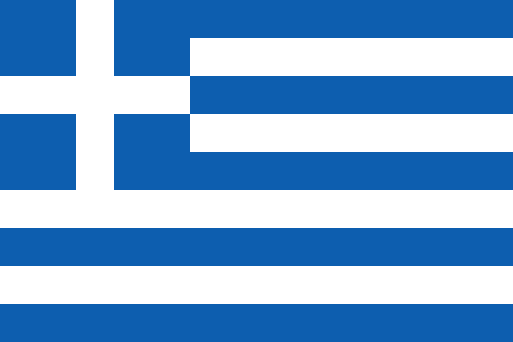
Hire in Greece
Begin your journey into human resources best practices and recruitment in the Netherlands right here.

Greek Currency
Euro (EUR)

The Capital of Greece
Athens
Time Zone in Greece
GMT+2
Important Facts About the Country of Greece
Introduction to Greece
Situated at the intersection of Europe, Asia, and Africa, Greece operates as a parliamentary representative democratic republic, led by a president as the head of state and a prime minister as the head of government within a multiparty system. Despite grappling with a persistent sovereign debt crisis, navigating business affairs in Greece presents obstacles. Taxation policies lack favorability towards businesses, and corruption remains prevalent across various sectors. Nevertheless, there are notable strengths, such as a well-educated and proficient workforce. Additionally, Greece boasts low labor expenses alongside a robust entrepreneurial heritage.
What to Know about Greece’s Geography
To the northwest, Greece shares borders with Albania, while to the north, it is bordered by North Macedonia and Bulgaria. Its northeastern border is defined by Turkey. The Greek mainland is flanked by the Aegean Sea to the east and the Ionian Sea to the west. To the south, Greece is bordered by the Cretan Sea and the Mediterranean Sea. Covering a total land area of 131,957 square kilometers, Greece’s territory includes numerous islands, comprising one-fifth of its total land area.
Climate in Greece
Greece experiences a predominantly Mediterranean climate, characterized by mild, rainy winters and hot, dry summers, a pattern evident along its coastal regions. In the mountainous regions of Northwestern Greece and central Peloponnese, an Alpine climate prevails, distinguished by substantial snowfall.
The Culture of Greece
Greece holds a significant place as the birthplace of Western culture and democracy. Many modern democracies draw inspiration from Greek principles of governance by the people, trial by jury, and the concept of equality under the law. The country’s cultural legacy is characterized by a masterful blending of elements from ancient Greek mythology, Byzantine splendors, and European modernity. These influences collectively shape the cosmopolitan essence of contemporary Hellenism.
Religions Observed in Greece
The Greek Constitution acknowledges Eastern Orthodoxy as the predominant faith of the nation, while simultaneously safeguarding the freedom of religion for all individuals. Approximately 97% of Greek citizens self-identify as Eastern Orthodox and are affiliated with the Greek Orthodox Church. However, the Greek government does not compile statistics on religious groups, nor does it inquire about religious affiliation in the census.
Languages Spoken in Greece
The official language of Greece is Standard Modern Greek, spoken by the majority of the native population. In addition to Greek dialects, various non-official minority languages are also spoken. Among Greeks, English, German, French, and Italian are the most commonly learned foreign languages. Official statistics indicate that approximately 51% of the population can speak English to some extent.
Greek Human Resources at a Glance
Employment Law Protections in Greece
In Greece, the regulations governing employment relationships are established in the following hierarchical order:
- Constitution
- International treaties
- Greek labor law
- Collective employment agreements and arbitration awards
- Employment regulations
- Established business customs
- Individual employment contracts
The labor law framework in Greece operates on the principle of protection, wherein the regulation most advantageous to the employee takes precedence.
Employment Contracts in Greece
Employers must furnish their employees with written or electronic notification containing the fundamental terms of their employment. An electronic format is permissible provided it is downloadable and printable, and the employer can demonstrate delivery. Within one week of commencing employment, the employer must disclose the following fundamental terms to the employee:
- Identifications of both parties
- Workplace location
- Position title and job duties
- Commencement and termination dates of employment
- Duration and terms of any probationary period
- Salary, working hours, and schedule of the employee
Greece's Contract Terms
Employees, whether under a fixed-term or open-ended contract, must receive notification of their employment terms within two months of commencing work. This notification must be documented in writing, either as a formal employment contract or as a written document outlining the essential provisions. Failure to provide written notification may result in fines for the employer.
Other conditions, such as annual wage increases, cost-of-living adjustments, allowances, benefits, and equal access to promotional opportunities, are typically determined by collective agreements and internal company regulations.
Pre-Employment Checks
When conducting a background check, employers should only gather information essential for determining the suitability for employment.
Employers may request and process employees’ health data solely for assessing their suitability and capability for the relevant position.
Personal data should primarily be obtained directly from the prospective employee. Collection from third parties, such as previous employers, is permissible under specific circumstances and requires the prospective employee’s consent.
Greece's Guidelines Regarding Probation Period/Trial Period
Throughout the probationary period, employees undergo evaluation to assess their suitability for the role. This period typically spans up to six months and, upon successful completion, is recognized as working time, entitling employees to all pertinent rights.
For fixed-term employment agreements, the duration of the probationary period should be proportional to the agreement’s length. It cannot exceed one-quarter of the total agreement duration or six months, whichever is shorter.
Regulations and Rules Regarding Working Hours in Greece
The standard workweek in Greece consists of 40 hours, spread across five days with an average of eight hours per day. No single workday should exceed 10 hours.
In the case of organizations operating under a continuous system of rotating shifts, where employees work a five-day week, they may be permitted to work on the sixth day, provided it is officially recorded by the employer on the ERGANI platform before the commencement of work. Employees working on this additional day must not exceed eight hours of work, and overtime or additional tasks are not permitted. The employer is required to compensate employees for the sixth day’s work with regular pay and an additional premium of 40%.
Greek Laws Regarding Overtime
Work exceeding 45 hours per week is considered overtime and necessitates payment at a 50% premium. The maximum allowable overtime hours per year are 120. Should this limit be surpassed, additional work must be compensated at a 75% premium.
Parties involved can mutually agree on alternative working time arrangements. Nevertheless, employees cannot forfeit their minimum rights concerning overtime work.
Employers are obligated to maintain records of any overtime hours worked by employees.
Rules Regarding Bonus and 13th Month Pay in Greece
Greek employees receive bonuses throughout the year equivalent to an additional two months’ salary. These bonuses consist of a full month’s salary for Christmas, half a month for Easter, and another half a month for a vacation bonus.
Termination
Both parties have the right to terminate an indefinite-term employment contract without providing a reason. The employer is not obligated to justify the dismissal, although certain restrictions apply in specific circumstances, such as for pregnant women or employees on leave.
Indefinite-term employment contracts can be terminated in two ways:
- Regular termination, which involves providing prior notice. This applies mainly to white-collar employees.
- Irregular termination, which occurs without prior notice.
Termination Procedures:
Terminations must always be documented in writing and provided to the employee.
Severance payments must be made via bank transfer before delivering the termination document. Proof of transfer must be given to the employee along with the termination document.
The termination document must be submitted to the ERGANI information system within the specified timeframe for official notification.
Both parties must sign the termination document and submit it to the ERGANI electronic system within the legislated period.
Employees terminated without notice are entitled to compensation based on their length of service.
If an employee is absent without justification for more than five consecutive days, the employer issues a written notice uploaded to the ERGANI platform. Failure to return to work within five days of this notice is considered grounds for presumption of resignation.
Greece's Requirements Regarding Notice Periods
For dismissals with prior notice, the length of the notice period is determined by the employee’s tenure as follows:
- Up to 12 months of employment: No notice required.
- 1-2 years of employment: 1 month’s notice.
- 2-5 years of employment: 2 months’ notice.
- 5-10 years of employment: 3 months’ notice.
- More than 10 full years: 4 months’ notice.
Redundancy/Severance Pay in Greece
Severance pay is determined based on the employee’s length of service and is computed as follows:
- One to four years of service: Two months’ pay
- Four to six years of service: Three months’ pay
- Six to eight years of service: Four months’ pay
- Eight to 10 years of service: Five months’ pay
- 10 to 11 years of service: Six months’ pay
- 11 to 12 years of service: Seven months’ pay
- 12 to 13 years of service: Eight months’ pay
- For each additional year of service thereafter, one month’s extra pay is added, until reaching 16 years of service, where the payment remains at 12 months’ pay.
Severance payment is a mandatory component for the validity of dismissal, whether it’s with or without prior notice.
Post-Termination Restraints / Restrictive Covenants
A written post-termination non-competition agreement is typically deemed lawful and enforceable under the following conditions:
- It is necessary to safeguard the legitimate business interests of the employer.
- It is restricted in terms of duration, geographic scope, scope of activity, or industry.
- It accounts for the expertise and situation of the employee.
- A fair compensation is agreed upon and provided to the employee.
Fixed Term Contacts for Greek Employees
Employers in Greece are barred from utilizing fixed-term contracts for permanent positions. Probationary periods for such contracts must be established before employment commences.
Key provisions for fixed-term contracts include:
- **Written Agreement:** Fixed-term contracts must be documented in writing, specifying the explicit objective reason justifying the contract’s renewal or extension.
- **Duration Limitation:** Successive fixed-term contracts cannot surpass a cumulative duration of three years.
- **Renewal Restriction:** Within a three-year span, there is a limit of three successive contract renewals.
- **Termination Terms:** Contracts conclude on the agreed-upon end date without requiring notice or severance pay. However, early termination is permissible only with substantial justification.
- **Equal Treatment:** The principle of equal treatment applies, unless objective reasons warrant differential treatment.
- **Contract Duration Exceedance:** If a contract’s duration surpasses the specified limit or there are consecutive contracts without a 45-day gap, it is presumed to fulfill permanent business needs. The burden of proof falls on the employer.
- **Unlimited Renewal:** Continuous renewal of fixed-term contracts is allowed if justified.
Tax and Social Security Information for Employers in Greece
Personal Income Tax
There are three categories of employment-related taxes:
- Income tax on salaries
- Solidarity levy
- Tax on severance payments
Monthly earnings from employment and pensions, encompassing non-monetary benefits, are subjected to withholding tax according to the rates outlined in the following tax rate table:
1. Salary Tax
| Monthly Income (€)* | Tax Rate (%) |
|---|---|
| 0 – 10,000 | 9.0 |
| 10,001 – 20,000 | 22.0 |
| 20,001 – 30,000 | 28.0 |
| 30,001 – 40,000 | 36.0 |
| >40,001 | 44.0 |
*Earnings, Retirement Benefits, Entrepreneurial Ventures
2. Solidarity Levy
| Annual Income (€) | Progressive Rate (%) |
|---|---|
| 0 – 12,000 | 0.0 |
| 12,001 – 20,000 | 2.2 |
| 20,001 – 30,000 | 5.0 |
| 30,001 – 40,000 | 6.5 |
| 40,001 – 65,000 | 7.5 |
| 65,001 – 220,000 | 9.0 |
| >220,000 | 10.0 |
3. Severance Payment Tax
| Annual Income (€) | Tax Rate (%) |
|---|---|
| 0 – 60,000 | 0.0 |
| 60,001 – 100,000 | 10.0 |
| 100,001 – 150,000 | 20.0 |
| >150,000 | 30.0 |
An individual is responsible for paying income tax on their entire net income, both earned within Greece and abroad. Income earned within Greece is subject to taxation regardless of the individual’s place of residence. However, income earned abroad is only taxed if the individual is a resident of Greece.
Employers are tasked with managing an employee’s solidarity tax, income tax, and social security contributions (IKA). These tax deductions must be processed and submitted by the end of each month. Failure to meet this deadline incurs a penalty equal to 10% of the total amount owed.
4. Deduction From Pay
The employer deducts the employee’s social security contributions from their gross monthly salary and remits both the employee and employer contributions directly to the social security authority.
| Contribution Rate | Employee (%) | Employer (%) |
|---|---|---|
| Pension Fund (IKA) | 6.67 | 13.33 |
| Supplementary Pension | 3.00 | 3.00 |
| Health Benefits in Kind (IKA) | 2.55 | 4.55 |
| Other (Unemployment, LAEK, Labour) | 1.65 | 1.41 |
| TOTAL | 13.87 | 22.29 |
*Please note that the rates mentioned above are provided as general guidance. Actual rates may vary and will be specific to GoGlobal’s policies and agreements.
Important Information for Greek Employees
Salary Payment
Salary payments are typically made on a monthly basis, with disbursement occurring on the same day each month and no later than the final working day of the month.
Payslip
In Greece, employers have the legal authorization to furnish employees with digital payslips.
Timesheets & Record Keeping
Employers are mandated to retain payroll reports for a minimum of 10 years. Additionally, they are required to establish an electronic system for recording employees’ work hours, which must be linked in real-time to the “ERGANI” platform. The Digital Employment Card, introduced in June 2021, is utilized to record various details such as the commencement and conclusion of daily work, breaks’ duration, and any overtime exceeding the regular working hours. This card is instrumental in ensuring employers adhere to legal regulations regarding employee work schedules.
Annual Leave
The entitlement to annual leave for salaried employees is contingent upon their length of service and the structure of their work week. Upon commencement of employment, every employee, whether on an indefinite or fixed-term contract, is entitled to a proportionate allocation of leave days based on their weekly work schedule of either five or six days.
For each calendar year, employees with a five-day work week are entitled to 20 to 26 work days of leave, while those with a six-day work week are entitled to 24 to 31 work days. The precise number of leave days granted is determined by the employee’s tenure with the employer.
After the first year of employment, the annual leave entitlement increases by one work day for each subsequent year of service, reaching a maximum of 22 work days for those on a five-day work week and 26 work days for those on a six-day work week.
Employees who have completed 10 years of service with the same employer, or 12 years of service overall, are entitled to 25 work days of leave for a five-day work week or 30 work days for a six-day work week.
Furthermore, employees who have completed 25 years of service with the same employer or any employer are entitled to 26 work days of leave for a five-day work week, or 31 work days for a six-day work week.
It’s important to note that annual leave must be utilized by the end of the first quarter of the subsequent calendar year.
Sick Leave
Employees are eligible for sick leave due to “short-term sickness” for a duration of up to six months, provided they present a valid medical certificate. The entitlement to sick leave benefits is contingent upon the employee’s tenure with the employer and varies accordingly. The compensation amount is also determined by the employee’s length of service with the employer.
Short-term sickness is categorized as follows:
- One month of sick leave for employees with up to 4 years of service
- Three months of sick leave for employees with 4 to 10 years of service
- Four months of sick leave for employees with 10 to 15 years of service
- Six months of sick leave for employees with more than 15 years of service with the same employer
During the specified sick leave periods, employees are entitled to receive salary compensation according to the following guidelines:
- Up to 15 days’ pay (equivalent to half of the salary) for employees with a tenure of between 10 days and one year with the current employer
- Up to one month’s salary for employees who have completed one year of employment with the current employer
Compassionate & Bereavement Leave
Leave entitlements for various circumstances are as follows:
- Medically-assisted reproduction leave: seven working days
- Special maternity leave for surrogacy and adoption
- School leave for children up to 18 years of age: up to four working days
- Wedding leave: five or six work days, depending on the work schedule
- Prenatal examination leave: employees may take leave without deduction from salary
- Leave for caring for a child with a disability: Employees at companies with more than 50 employees can request a reduction of one hour in their daily employment
- Leave to care for sick dependents: Six days as a base, extended to eight days for employees with two children or 14 days for employees with three or more children
- Single parents’ leave for children up to 12 years old: Six days as a base, extended to eight days for single parents with three or more children
- Leave in case of a child’s serious health issue (children up to 18 years old): Up to 10 work days per year
- Leave in case of a child’s hospitalization (children up to 18 years old): Up to 30 working days per year
Caretaker Leave
Employees who have worked for six months are entitled to paid caretaker leave, amounting to five work days per calendar year. This leave is intended for caring for a relative or another individual residing in the employee’s household and requires a medical certificate for validation.
Moreover, each parent or caretaker is eligible for two paid working days off for pressing family matters arising from sickness or accidents.
Maternity & Parental Leave
Maternity Leave
Female employees are granted a nine-week maternity leave following childbirth, inclusive of all relevant remuneration and benefits. This entitlement extends to women adopting a child up to eight years old and those having a child through surrogacy.
Paternity Leave
New fathers are entitled to 14 working days of leave, which can be utilized in either of the following two ways:
- The initial two days may be taken before the anticipated birth date, with the remaining days utilized within 30 days after the birth.
- All days can be taken following the birth date.
In instances of adopting a child up to eight years old, paternity leave commences upon the child’s integration into the family.
Parental Leave
Any parent with at least one year of tenure with the employer can avail themselves of a four-month parental leave, which can be taken continuously or intermittently until the child reaches eight years of age. This provision also encompasses parents of adopted children up to eight years old, starting from the child’s integration into the family.
During the initial two months of parental leave, the Manpower Employment Organization (OAED) disburses a monthly parental leave allowance equivalent to the minimum statutory salary to each parent. These parents also receive a prorated Christmas and Easter Bonus, as well as an annual leave allowance based on their entitlement.
If a parent has multiple children, they are entitled to leave and the corresponding allowance for each child. However, one year of actual employment with the employer must be completed from the conclusion of the previous parental leave period for this provision to apply.
Single parents, following the other parent’s demise or the removal of their parental responsibilities, are entitled to double the days and allowance corresponding to parental leave.
The application for parental leave must be registered in ERGANI. This leave period is recognized as actual employment time for the calculation of remuneration, annual leave entitlements, and severance compensation in case of employment termination.
Public Holidays
There are six official public holidays that employers must recognize: New Year’s Day, Independence Day, Easter Sunday, Easter Monday, Assumption Day, and Christmas Day. Additionally, Labor Day and Ochi Day are designated as optional holidays by law, although it is common for employees to have these days off as well.
Beyond the official public holidays recognized by the Ministry of Labor, Greece celebrates more public holidays, some obligatory and some optional. The list of these non-fixed National Holidays remains largely consistent, resulting in a total of 12 national holidays observed each year.
Benefits to the Employee in Greece
Greek Statutory Benefits
The social security system in Greece encompasses several components, including:
- Primary pension
- Supplementary pension
- Health insurance
- Welfare benefits
- Specific benefits such as unemployment support
Primary pension and health insurance are mandatory for all workers, while supplementary pension and other benefits may vary depending on the industry sector.
For teleworking arrangements, employers are required to provide minimum monthly payments to cover associated expenses:
- €13 for the use of the employee’s home office
- €10 for telecommunication expenses
- €5 for equipment maintenance costs
Rules Regarding Visas and Foreign Workers in Greece
General Information
To work in Greece, individuals must obtain a long-stay visa and a residence permit, with restrictions on permits based on region and job specialization.
The Immigration and Social Integration Code of Greece outlines various categories of residence permits for expatriate employment, including those for special-purpose work, investment activities (with limits on permits per investment), and highly skilled employment under the EU Blue Card program.
Certain residence permits, such as those for board members, legal representatives, and executives of Greek or foreign companies in Greece, have no specific limitations. However, other criteria apply, such as minimum employment duration and company size.
Getting a Tax Number
An AFM, or tax roll number, is a necessary document for legal employment in Greece, enrolling in national insurance schemes, opening a bank account, and other official functions.
To obtain an AFM, individuals can visit a local Greek tax office (known as ‘Eforia’). Alternatively, an accountant or lawyer can assist in obtaining one on behalf of the applicant. The application process typically requires providing documents such as a passport or ID card, a travel document for non-EU foreigners, and a marriage certificate if applicable. All documents must be submitted as certified copies.
Public Holidays Recognized by Greece in 2024
| Occasion | Date | |
|---|---|---|
| 1 | New Year’s Day | January 1 |
| 2 | Epiphany | January 6 |
| 3 | Independence Day | March 25 |
| 4 | Labour Day | May 1 |
| 5 | Orthodox Easter Monday | May 6 |
| 6 | Assumption Day | August 15 |
| 7 | Ochi Day | October 28 |
| 8 | Christmas Day | December 25 |
| 9 | Second Day of Christmas | December 26 |
Hire New Talent in Greece
Our global hiring services enable you to onboard personnel in any country without the financial commitment required to establish a local entity.