

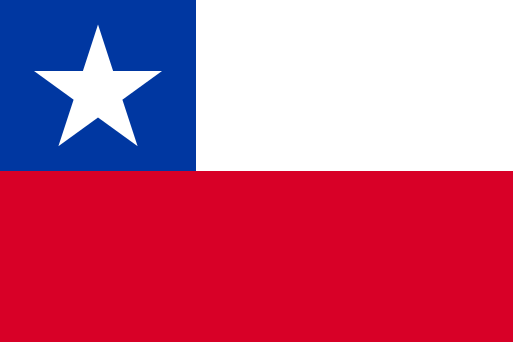
Hire in Chile
This is the starting point for delving into human resources best practices and initiating the hiring process in Chile.

Chilean Currency
Chilean Peso (CLP)

The Capital of Chile
Santiago
Time Zone in Chile
GMT-4
Important Facts About the Country of Chile
Introduction to Chile
Chile, officially known as the Republic of Chile, is situated in western South America. Boasting a population of slightly over 19 million, it comprises 16 regions, 56 provinces, and 348 communes. Santiago (Santiago de Chile) serves as both the capital and the largest city of the nation. Chile stands as a high-income economy, recognized for its transparency and stability. Furthermore, the country houses a mature and responsive financial market, characterized by receptivity and dynamism.
What to Know about Chile’s Geography
Spanning 756,096 square kilometers, Chile stands as the world’s southernmost country, situated closest to Antarctica. Its geographical neighbors include Peru to the north, Bolivia to the northeast, Argentina to the east, and the Drake Passage in the far south.
Climate in Chile
Chile boasts a varied climate, encompassing the world’s driest desert in the north, specifically the Atacama Desert, a Mediterranean climate in the central region, and subtropical, oceanic, alpine tundra, and glaciers in the eastern and southern parts of the country.
The Culture of Chile
Chile’s cultural landscape was predominantly shaped by Spanish influence during the colonial and early Republican periods. The 19th century introduced additional European influences that continue to influence Chilean culture today. Before the colonial era, the northern region of Chile exhibited Andean cultural elements influenced by Altiplano traditions.
Religions Observed in Chile
More than 55% of Chile’s population adheres to the Roman Catholic faith, while approximately 13% are affiliated with Evangelical churches, encompassing various Christian denominations outside of Roman Catholicism and Orthodoxy.
Languages Spoken in Chile
The primary language spoken in Chile is Spanish, and German is used to some extent in Southern Chile. While several indigenous languages, such as Aymara, Rapa Nui, and Quechua, exist, they have become minority languages and are at risk of extinction.
Chilean Human Resources at a Glance
Employment Law Protections in Chile
The Chilean Labor Statute comprises the Labor Code (Código del Trabajo) along with various special social security laws. Every employee is required to be associated with a Pension Fund Administrator (AFP) of their choosing, contributing to the Survival & Disability Insurance Fund, Individual Savings Insurance, and commission payments. Additionally, employees must have health insurance, either through state FONASA or private ISAPRE, as well as labor-related accident insurance and unemployment insurance, paid to AFC.
Key Points – Employers should prepare for:
- Chile’s labor laws are designed to safeguard the rights of employees.
- Whether for cause or without cause, terminations in Chile must be documented in writing.
- The labor courts, known for prioritizing employee rights, typically make rulings in favor of employees.
- These courts adhere to the ‘rule of reason’ in their judgments.
The following must be considered for determining employees’ and employers’ rights and obligations:
- The rights and responsibilities of employers and employees in Chile are rooted in various legal sources, encompassing the National Constitution, the Labor Code, statutes/decrees, and judicial and administrative precedents.
- Chile’s National Constitution delineates employment and social security rights, covering aspects such as unions, collective bargaining, and prohibiting employment discrimination based on factors other than personal ability.
- The Labor Code comprises five books addressing individual labor contracts, employee protection, labor unions, collective negotiations, and labor jurisdiction.
- While labor statutes may lack intricate details, judicial and administrative decisions play a crucial role in defining rights and obligations within employment relationships.
- The enforcement of labor laws is primarily overseen by the Labor Directorate, tasked with ensuring employers adhere to labor regulations.
Employment Contracts in Chile
An employment agreement in Chile must be documented and finalized within 15 days from the commencement of the employee’s services. If the contract spans less than 30 days or lacks specified terms, the execution window is reduced to five days.
Failure to formalize the labor contract within the stipulated timeframe places the onus on the employer to prove the terms, with the employee providing indications.
The essential clauses to be included in the labor contract are:
- Date and place of execution
- Employee’s nationality and date of birth
- Commencement date
- Description of the services to be performed, including the service location
- Remuneration details, including amount, timing, and form of payment
- Work hours and schedule
- Contract duration
- Cash or in-kind benefits
- Any additional agreed-upon terms
Restrictive covenants (e.g., non-compete and confidentiality) can be enforced during employment, subject to mutual agreement.
Post-employment restrictive covenants are permissible under certain conditions (e.g., safeguarding confidential information), provided they meet criteria such as employee consent, legitimate business interest protection, limited scope/timeframe, and consideration.
Important Information for Indian EmployeesImportant Information for Indian Employees
Chile's Contract Terms
- Individual employment contracts
- Collective employment contracts (covering general labor conditions, fixed-term remuneration, or benefits in kind)
- Special contracts (such as apprenticeships, agricultural contracts, maritime/dock agreements, and domestic assistance agreements)
Duration
Broadly speaking, the duration of an employment contract may fall into one of the following categories:
- Indefinite or permanent
- Fixed time period
- Until the completion of a specific event or task
Chile's Guidelines Regarding Probation Period/Trial Period
- For other employees, a fixed-term agreement is commonly employed as an informal probationary period. The employer has the option to extend this ‘probationary period’ up to a maximum duration of one or two years, depending on the job’s nature.
- Following successful evaluation, the labor contract may be renewed, or an indefinite (permanent) contract can be established if the employee is deemed suitable for the position.
Regulations and Rules Regarding Working Hours in Chile
- The maximum weekly working hours are limited to 45, spread over a minimum of five and a maximum of six days.
- Exempted from these restrictions are employees with managerial authority, those working without direct supervision, and those working remotely or at locations other than the central workplace.
- Furthermore, the standard duration of a workday must not surpass 10 hours.
Chilean Laws Regarding Overtime
- Work exceeding 10 hours per day or 45 hours per week is classified as overtime.
- However, a maximum of two hours of overtime is permissible daily, preventing any employee from working beyond a total of 12 hours in a single day, given the standard ‘ordinary’ limit of 10 hours.
- Employees excluded from the hourly limitations, such as managers, do not qualify for overtime pay. Overtime agreements are temporary and must not extend beyond three consecutive months. Any additional hours worked must be documented in writing, and parties cannot waive overtime pay through mutual agreement.
- Overtime compensation is set at 1.5 times the regular hourly wage.
Health and Safety in the Workplace
Businesses are required to possess an internal regulation handbook (Reglamento Interno) outlining the health and safety regulations of the country. This includes:
-
The Internal Regulations on Organization, Health, and Safety, as stipulated and governed by the Chilean Labor Code. Employers are mandated to draft this document, and any company with 10 or more permanent employees is legally obliged to have it in effect.
-
Additionally, every company, irrespective of its workforce size, must adhere to the regulations outlined in the Industrial Accidents and Occupational Hazards in the Workplace Law.
Termination
- Mutual agreement of both employer and employee
- Employee’s voluntary resignation
- Death of the employee
- Expiry of the agreed fixed-term in the contract
- Fulfillment of the project or work for which the employee was hired
- Circumstances beyond the control of both parties (force majeure)
- Company needs arising from changes in market conditions or the economy
- Dismissal by the employer
It is important to note that, as a general principle, employers in Chile are not allowed to terminate a labor contract arbitrarily. Terminations must be justified by a legitimate business need related to the company. In recent times, courts have shown increasing strictness in evaluating whether the cited business grounds are sufficient to warrant a termination.
Positions of trust, such as managers or employees authorized to broadly represent the company, can be terminated without the necessity of citing business needs. A written notice of termination is sufficient.
- Employees may face dismissal without compensation in instances of severe misconduct or contractual breaches.
- Special protection is afforded to employees during specific periods, such as maternity leave (and one year thereafter) and when involved in various trade union activities. When under this special protection, termination requires prior court authorization.
- Upon termination of an employment contract, the employer must adhere to specific procedures, including the creation of a “final settlement” within ten working days. This document confirms the conclusion of the employment relationship and verifies that the employee has received all due payments.
- In certain situations, such as when the employer seriously breaches the employment contract, an employee has the right to terminate the agreement and seek compensation through the courts, referred to as an “indirect” dismissal.
- Should a court deem the termination of an employee’s contract as unjustified, unfair, or lacking legal grounds, the employee is entitled to compensation.
Chile's Requirements Regarding Notice Periods
If dismissal occurs on specific grounds, such as redundancy, the employer is obligated to provide the employee with a minimum of 30 days’ notice or, alternatively, one month’s pay in lieu of this notice. Conversely, in the case of resignation, an employee is typically required to give at least 30 days’ notice.
Restrictive Covenants
Chile lacks explicit labor regulations that specifically address or forbid restrictive covenants. Nevertheless, the country’s Constitution explicitly safeguards the employee’s right to work and their freedom of choice.
Within an employment agreement, the following restrictive covenants can be incorporated and may be legally enforceable:
- Non-compete clauses
- Non-solicitation of customers
- Non-solicitation of employees
Post-employment non-compete clauses have been acknowledged as valid when documented in writing, accompanied by compensation to the employee, and possess a reasonable duration. However, practical enforceability of such clauses can be challenging.
Redundancy/Severance Pay in Chile
If a labor contract is terminated due to the company’s needs, such as downsizing or changes in economic conditions, or in the case of termination at will (where permitted by law), the employer is required to provide severance pay in the following manner:
- An amount equivalent to one month of salary for each year worked, prorated if the employee’s service exceeds six months.
- If the termination notice is less than 30 days, the employee is entitled to severance compensation equivalent to one month’s remuneration.
In both scenarios mentioned above, the severance payment can be waived if mutually agreed upon by both parties.
In Chile, the general principle is that the payment of severance is governed by the contractual agreement. If no agreement exists or if the agreed amount is lower than the legally mandated severance pay, the legal severance must be provided.
However, if an employee is dismissed for cause, such as a serious breach of contract or material misconduct, the right to severance compensation does not apply.
Upon termination of the labor contract, the employer must specify the total sum, inclusive of social security contributions, bonuses, or any monetary valued items. This sum excludes occasional benefits received by the employee.
Trade Unions / Collective Agreements in Chile
- The ability to form labor organizations (unions, federations, or confederations) without prior authorization is recognized. These unions are subject to regulation outlined in the Labor Code, and membership is both personal and voluntary.
- The primary objective of these organizations is to represent employees in the exercise of their rights, facilitate collaboration between employers and employees, promote educational initiatives, and enhance workplace safety.
- Employees are allowed to be affiliated with only one union for each position of employment they occupy.
- Multiple unions have the possibility to coexist within a single company.
- According to the law, the union is the sole entity authorized to represent employees in a collective bargaining process.
- Strikes are prohibited in utility sectors, such as those providing electricity or water, as well as in activities with the potential for significant harm to the country’s security or economy. In such instances, mandatory arbitration is enforced.
Fixed Term Contacts for Chilean Employees
- The duration of fixed-term contracts is established at the time of their initiation.
- These contracts are limited to a maximum duration of one year or, under exceptional circumstances, two years for individuals in managerial roles or those possessing professional or technical qualifications from a higher education institution.
- Renewal of fixed-term contracts is permissible only once. If renewed for a second time, they automatically convert into indefinite contracts. This condition also applies if an employee continues to provide services beyond the contract’s expiration, and the employer is aware of such continuation.
- If an employer terminates the contract before the agreed-upon date, they are obligated to compensate the employee for the full contractual period.
- Tasks or stages within a specific job are not considered separate successive fixed-term contracts; instead, they are presumed to constitute an indefinite contract.
- Contracts that engage an employee for permanent services are not categorized as contracts for a specific job.
- Fixed-term contract employees are entitled to vacation and special termination severance, provided specific requirements are met.
Tax and Social Security Information for Employers in Chile
Personal Income Tax in Chile
Taxes are typically deducted at the source of income in accordance with the Impuesto único de Segunda Categoría. Employers are required to make monthly contributions between the 10th and 12th of each month. Within 60 days of hiring, all new employees must be registered with tax authorities.
Chile imposes taxes on residents’ global income using progressive rates ranging from 0% to 40%. The specific rates are determined by income brackets measured in tax units, with their value in CLP reviewed monthly.
For the initial three years in Chile, foreign employees are taxed only on their Chilean-source income, after which they become liable for taxes on their worldwide income. Non-residents face a 15% flat tax on technical and professional services and a 35% flat tax on other work.
Social Security in Chile
In Chile, the majority of social security expenses are deducted from the employee’s earnings rather than covered by the employer. It’s important to highlight that the Chilean Social Security System is managed by private entities and operates under government oversight. This transition to a privately-administered system took place in 1980.
| Type of Insurance | Paid by employer | Paid by employee | Total |
|---|---|---|---|
| 1. Pension Fund*, comprising: | |||
| Disability & Survivors Insurance (Seguro de Invalidez y Sobrevivencia – SIS) | 1.49% | 0.00% | 1.49% |
| Individual Saving Insurance | 0.00% | 10% | 10% |
| Commission to Affiliate AFP | 0.00% | 0.49 – 1.44% | 1.44% (maximum) |
| 2. Health Insurance | 0.00% | 7% (minimum, employee decides) | 7% |
| 3. Workplace Accident Compensation Fund (Mutual) | 0.00% | 0.93% | 0.93% |
| 4. Unemployment Pension Fund (Cuenta Individual de Cesantia – CIC) | 2.4% | 0.6% | 3.0% |
| Total | 3.89% | 19.97% (maximum) | 23.86% |
*Each employee is required to enroll with a Pension Fund Administrator (AFP) of their preference. Employees have the flexibility to decide whether to contribute to a government-managed plan (FONASA) or opt for a private insurer (ISAPRES).
**The provided table serves as a general reference. The actual rates billed by GoGlobal to clients may vary.
Important Information for Chilean Employees
Salary Payment
Compensation may be disbursed on a monthly, weekly, or daily basis, but it must adhere to a consistent schedule. The payment unit should not exceed one month.
Payslip
Salary statements must be provided at least once a month, presenting a comprehensive breakdown of the remuneration disbursed.
Annual Leave
Employees who have worked for a year or less have the right to the annual paid vacation of 15 working days. The holiday must be continuous but an excess over 10 days can be divided by mutual agreement.
After working 10 years, regardless of whether the tenure is continuous or for the same or different employers, vacations are increased by one working day for every three years of service with the current employer.
In the 11th region (Región de Aysen del General Carlos Ibañez del Campo) and 12th region (Región de Magallanes y Antartica Chilena) of Chile
Sick Leave
There is no annual limit on the duration of sick leave an employee can take, but the entitlement depends on the medical certificate provided by a doctor. To qualify for sick leave, employees must submit a medical certificate to the employer within two working days from the onset of the sick leave.
Within three working days, the employer is required to submit the medical leave certificate to the health insurance institution (ISAPRES or FONASA), which covers the sick leave expenses, potentially subject to certain limits.
The sick leave rules are as follows:
- For three or fewer days of sick leave, employees are not eligible for sick pay.
- For sick leave lasting between four and 10 days, employees are entitled to sick pay.
- If sick leave extends beyond 10 days, employees are entitled to sick pay for all working days during the sick leave period.
Compassionate & Bereavement Leave
Workers are entitled to receive compensation for bereavement leave under the following circumstances:
- In the event of the death of a child or spouse/civil partner, employees have the right to take seven calendar days of leave, in addition to their annual leave entitlement, and this can be availed regardless of their tenure with the employer.
- If an employee experiences the death of a parent, they are entitled to a three-business-day leave starting from the date of the parent’s demise.
- In the unfortunate event of the death of an unborn child, both male and female employees are eligible for three business days of leave, which commences from the confirmed date of death with a valid fetal death certificate. Furthermore, employees who suffer the loss of a child or spouse are granted tenure protection for one month, beginning from the date of death.
Family Care Leave: In situations where the employee’s spouse, civil partner, father, or mother is in a terminal state, the employee may be granted 10 working days of paid leave, contingent upon providing a valid medical certificate.
Marriage/Civil Union Leave: Each employee is entitled to five consecutive working days of paid leave for marriage or civil union ceremonies, in addition to their annual leave. The employee can opt to use this leave on the day of the ceremony and on the days immediately preceding or following the event.
Other rights for leave of absence
Military/Training Leave: During military service or mobilization in the national reserves, an employee has the right to retain their job without pay. However, if reserve personnel are called in for less than 30 days, employers are obligated to provide compensation equivalent to regular wages.
Medical Examination Leave: Employees aged 40 and above for females and 50 and above for males, with employment terms exceeding 30 days, are entitled to half a day’s leave annually for essential preventive health examinations.
Vaccination Leave: In instances of public vaccination programs or campaigns aimed at controlling and preventing communicable diseases, all employees are entitled to half a day’s leave for vaccination.
Maternity & Parental Leave
Maternity Leave: Women employees are entitled to a six-week prenatal leave before delivery and a 12-week postnatal leave after childbirth. If delivery occurs more than six weeks after the maternity leave commencement, the prenatal leave extends until delivery. In instances where delivery occurs before the 33rd week of gestation or if the newborn weighs less than 1,500 grams, the postnatal leave is extended to 18 weeks.
During pregnancy and for one year from the conclusion of postnatal leave, female employees cannot be subject to dismissal.
In the case of multiple births, the postnatal rest period increases by seven consecutive days for each child born after the second.
If both parents are employees, either parent, as chosen by the mother, may take parental postnatal leave starting from the seventh week for the duration specified by the mother. In the event of the mother’s death during childbirth or the postnatal leave period, the leave will be granted to the father or the child’s legal guardian.
Breastfeeding Breaks: Employees are entitled to a minimum of one hour per day to feed their children under two years of age. This right can be implemented in any of the following ways, subject to agreement with the employer:
- At any time during the working day;
- Divided into two portions at the employee’s request;
- Postponed or advanced by half an hour or an hour at the beginning or end of the workday.
The time spent breastfeeding is considered working time and is non-negotiable for employees with children under the age of two years.
Adoption Leave: Employees who adopt a child, including women, single men, or widowers, are entitled to one year of unpaid adoption leave from the date when the court grants custody. If the adopted child is under six months old, the parent is entitled to an adoption allowance for 12 weeks.
Paternity Leave for Adoption: Fathers involved in the adoption process are entitled to paternity leave, starting from the notification of the resolution granting personal care or welcoming the adoption of the child.
Paternity Leave: Fathers are entitled to five continuous working days of paternity leave, usable at their discretion from the delivery date. This permission is also extended to fathers in the adoption process, with the leave counted from the notification of the resolution granting personal care or fostering the adoption of the child.
Shared Parental Leave: Fathers can also participate in parental leave, with the option of up to six weeks of full-time leave or 12 weeks of part-time leave.
Childcare Leave: A mother with a child under one year of age facing a serious illness is permitted leave during the period specified by the health service. This right is also extended to the spouse or civil partner. If both parents are eligible for leave, it is the mother’s decision on who takes the leave.
Employees (both parents) with a child older than one year and below 18 years, suffering from a serious accident or life-threatening illness, are entitled to paid leave equivalent to 10 working days per year. This can be distributed at the employee’s discretion in full, partial, or combined days.
Profit-Sharing
- In the event of the company generating profits, it is required to distribute 30% of the net profits among employees in proportion to their respective salaries. This distribution can occur on a monthly or annual basis.
- As an alternative to the aforementioned obligation, the company has the option to provide a bonus equivalent to 25% of the annual salary. However, irrespective of the salary level, the bonus cannot surpass the monthly minimum wage.
- A distinct profit-sharing agreement may be negotiated between the company and its employees, but any payment made to employees under such an agreement must not fall below the thresholds mentioned earlier.
13th Month Salary
The 13th salaries (Gratificación de Fiestas Patrias and Navidad) are required to be disbursed annually in two installments. The initial installment is paid during Fiestas Patrias (in September), while the second installment is paid at Christmas (in December).
Public Holidays
There are a total of 17 paid public holidays in Chile. In cases where a holiday coincides with a weekend, the Chilean government may opt to extend the holiday to either Friday or Monday. Presidential and parliamentary elections are conducted every four years on the third Sunday of November, and the election days for both Presidential and Municipal/Regional positions are designated as holidays.
Additionally, there are two local/regional holidays:
- June 7th – Battle of Arica (observed solely in the Arica and Parinacota Region)
- August 20th – Nativity of Liberator Bernardo O’Higgins (celebrated exclusively in the communes of Chillán and Chillán Viejo)
Benefits to the Employee in Chile
Chilean Statutory Benefits
There are five categories of employer social security contributions:
- Labor-related accident insurance: This pertains to employers’ associations of labor security, either private non-profit institutions or the Social Security Regularization Unit (ISL).
- Fondo SANNA: Designed for working parents of children aged one to 18 with serious health conditions, this allows parents to take a leave of absence from work to care for their children.
- Unemployment insurance
- Disability insurance
- Insurance for high-risk jobs: The contribution is 2% for heavy work or 1% for less heavy work.
On March 31, 2020, Congress approved legislation to safeguard workers and impose obligations on employers in cases of employment relationship suspension due to COVID-19. This allows employers and employees to agree on a labor relationship suspension, including reduced work hours with a proportional salary reduction. Under this arrangement, employees can receive unemployment insurance benefits of up to 25% of their salary, and employers are still obligated to make social security and health insurance payments, subject to certain ceilings during the suspension.
A new mandatory health policy for a gradual and safe return to work was also enacted. This policy covers hospital and worker rehabilitation expenses and provides indemnification in cases of death from COVID-19. It is applicable to workers performing in-person work, whether entirely or partially, with employees exclusively working remotely excluded from this obligation.
Other Benefits
It is customary to provide supplementary perks such as:
- Transportation allowance (Movilización)
- Meal allowance (Colación)
Rules Regarding Visas and Foreign Workers in Chile
General Information
The Work Contract Visa stands as the predominant long-term work authorization category in Chile, and the prerequisites for a foreigner to enter into a work contract in the country are as follows:
- The company, institution, or individual engaging a foreign worker must possess a legal address in Chile.
- The work contract must be executed before a notary, featuring the signatures of both the employer and the employee (or their legal representative).
- For professionals or skilled technicians, a certified degree from their country of origin is mandatory.
- The tasks to be undertaken by the foreign worker should not be deemed hazardous or pose a risk to the national security of the country.
The employment agreement and the hiring of the worker must adhere to all pertinent legal and labor regulations, including those specified by the aliens register office (Extranjería), which are essential for securing a Work Contract Visa.
Typically, a Work Contract Visa is issued for a duration of two years and can be indefinitely renewed for subsequent equal periods. Holders of this visa category are restricted to working solely for the entity that sponsored their visa.
Minimum requirements for a Work Contract Visa include:
- The place and date the contract was signed (must be signed before a notary).
- Names, nationalities, and addresses of both the employer and the employee.
- The task, mission, or project to be undertaken in Chile.
- Schedule and location where the work will be performed.
- The amount of remuneration, which must not fall below Chile’s minimum wage and can be paid in Chilean or foreign currency.
- Duration of the contract.
- Date of the commencement of activities.
- A travel clause stipulating that the employer commits to covering the cost of a return ticket for the worker and their family members to their country of origin or to a country agreed upon by both parties. This obligation persists until the foreign worker leaves the country, is granted a new visa, or obtains definitive continuance.
- A pension scheme clause in which the employer undertakes to facilitate the necessary arrangements for the worker to contribute to their future pension, unless both parties mutually agree to opt-out.
- An income tax clause, with the employer assuming responsibility for the payment of income tax corresponding to the foreign worker’s remuneration.
- The foreign worker is allowed to commence work upon obtaining certification of residency in Chile or the work permit for foreigners.
A work visa may be granted without charge and without a written work contract in the following cases:
- Artists, scientists, teachers, writers, and individuals who hold significant relevance in the cultural sphere.
- Individuals sponsored by public or private institutions with well-established funding.
- When an individual’s activities are conducted with charitable, educational, or knowledge dissemination purposes.
Temporary Residence Visa: Intended for foreigners with professional or family interests in Chile, this visa generally allows work for up to one year and is extendable for an additional year. Subsequently, the visa holder must apply for permanent residence.
Temporary Opportunity Visa for Entrepreneurs: Geared towards entrepreneurs aspiring to establish a business, invest, and reside in Chile, with a commitment to investing a minimum of approximately US$100,000 in the first year. This visa is renewable once, and a Spanish diploma at a minimum B1 level is required.
Temporary International Orientation Visa: Designed for individuals who have attained a certain level in selected top global universities, this visa permits individuals to work in Chile for up to 12 months, with the option of renewal.
Work Holiday Visa: Valid for 12 months, with a yearly cap on issued visas, this visa is open to applicants aged between 18 and 30.
Fees & Processing Time
The Chilean work visa fee is payable only after your application has been approved. The fees range from $50 to $150, and the specific amount is determined during the online application process. The processing time for a Chile work visa is typically 15-20 days. However, it’s important to note that Chilean embassies/consulates may not accept applications submitted less than 30 days in advance.
Getting a Tax Number
Chile has two types of ID numbers:
- RUT (Rol Único Tributario): This is the Chilean Tax ID number.
- RUN (Rol Único Nacional): This is the Civil Register ID number.
For individuals, whether Chilean or foreign residents in Chile, the RUT and RUN are identical. The Unique National Role (RUN) serves as a unique identification number assigned to every Chilean, regardless of their residence status in Chile. It is also provided to any foreigner, residing temporarily or permanently with a visa other than a tourist visa.
The agency responsible for issuing the RUN is the Civil Registry and Identification Service (Registro Civil). On the other hand, the RUT is allocated by the Internal Revenue Service (SII) upon request from entities such as companies, international organizations, tax offices, NGOs, etc.
Public Holidays Recognized by Chile in 2024
| Occasion | Date | |
|---|---|---|
| 1 | New Year’s Day | January 1 |
| 2 | Good Friday | March 29 |
| 3 | Labor Day | May 1 |
| 4 | Naval Glories Day | May 21 |
| 5 | Assault and Capture of the Morro de Arica | June 7 |
| 6 | National Indigenous Peoples Day | June 20 |
| 7 | Virgen del Carmen Day | July 16 |
| 8 | Assumption of the Virgin | August 15 |
| 9 | Birth of the Independence Hero | August 20 |
| 10 | Independence Day | September 18 |
| 11 | Day of the Glories of the Army | September 19 |
| 12 | Additional Holiday Fiestas Patrias | September 20 |
| 13 | Evangelical and Protestant Churches Day | October 31 |
| 14 | All Saints Day | November 1 |
| 15 | Christmas Day | December 25 |
Note: Talent is also required to adhere to local holidays stipulated by the city and/or state in which they reside.
Hire New Talent in Chile
Our global hiring solutions enable you to onboard personnel in any country without the investment required to establish a local entity.