

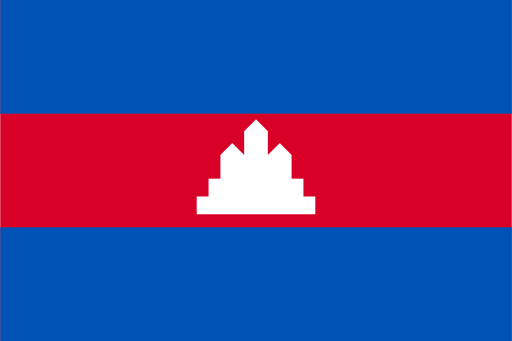
Hire in Cambodia
Embark on your journey into human resources best practices and recruitment in Cambodia by starting here.

Cambodian Currency
Cambodian Riel (KHR)

The Capital of Cambodia
Phnom Penh
Time Zone in Cambodia
GMT+7
Important Facts About the Country of Cambodia
Introduction to Cambodia
Situated in the southern part of the Indochina Peninsula in Southeast Asia, Cambodia, formally recognized as the Kingdom of Cambodia, boasts a population exceeding 15 million. The primary hub for politics, economy, and culture is Phnom Penh, serving as both the capital and largest city of the country.
What to Know about Cambodia’s Geography
Covering an area of 181,035 square kilometers, Cambodia shares its borders with Thailand to the northwest, Laos to the northeast, Vietnam to the east, and the Gulf of Thailand to the southwest.
Climate in Cambodia
Cambodia, situated in Southeast Asia along the Gulf of Thailand, experiences a consistently hot and tropical climate throughout the year. The southwest monsoon brings a rainy season from May to mid-November, followed by a dry season extending from mid-November to April. Given the country’s relatively small size, the climate remains generally uniform across different regions.
The Culture of Cambodia
Over the course of almost two thousand years, Cambodians cultivated a distinctive Khmer belief system through the fusion of native animistic beliefs with the Indian religions of Buddhism and Hinduism. The influence of Indian culture and civilization, encompassing language and arts, permeated Cambodia around the 1st century AD.
Religions Observed in Cambodia
Cambodia officially recognizes Buddhism as its primary religion, with around 97% of the population adhering to Theravada Buddhism. The remaining minority practices include Islam, Christianity, and tribal animism.
Languages Spoken in Cambodia
Khmer stands as the sole official language of Cambodia, spoken by almost 90% of the population. It serves as the language of choice in government administration, education, media, and various other domains. Following the Vietnamese language, Khmer ranks as the second most widely spoken Austroasiatic language globally.
Cambodian Human Resources at a Glance
Employment Law Protections in Cambodia
Labor relations, employment terms, and related matters in Cambodia are governed by the Constitution, as well as the 1992 Labor Law and the 1997 Labor Law. These legal frameworks provide significant protections and rights for both workers and unions.
The Cambodian Labor Law, along with its associated regulations, applies to all employer-employee relationships where work is conducted within the country. The nationality of the employer or employee, as well as the location of the labor contract signing, is irrelevant. As long as work is carried out in Cambodia, the labor law is applicable.
As a matter of public policy, no contract or agreement between an organization and an employee can override the rights or statutory benefits outlined in the Labor Law. The provisions established by the Labor Law are considered the minimum guarantee, and while companies have the freedom to offer more generous terms, it is not mandatory.
The Ministry of Labor and Vocational Training (MLVT), established by the government, oversees all employment matters in Cambodia, excluding judges of the judiciary, individuals with permanent posts in the public service, personnel of the police and army, and those in air and maritime transportation regulated by special legislation. Domestic or household servants are also excluded from its purview.
Employment Contracts in Cambodia
The contract must encompass essential details, including contract type, passport information, commencement and termination dates, position, salary, benefits, and job description. Failure to include these particulars renders any element of the employment contract invalid. To fall under the purview of the Labor Law, an individual must:
- Engage in work and receive remuneration.
- Operate under the direction and supervision of another person.
For independent contractors or those contracted for specific tasks, the second condition may not be applicable, exempting them entirely from the Labor Law.
A legally mandated employment contract must be in writing and signed by both the employee and employer.
- There are two contract types: Undetermined Duration Contract (UDC) and Fixed Duration Contract (FDC).
- According to Cambodian Labor Law, a contract for work with a specific duration is categorized as a fixed duration contract.
FDC applies when:
- The contract is documented.
- Specific start and finish dates are stipulated.
- The total contract duration, including any renewal period, does not exceed four years.
If any of these conditions are unmet, the contract is designated as a contract of unspecified duration (UDC). Consequently, an employee working continuously for a single employer for over two years is automatically considered to be on a UDC.
Should a contract meet FDC requirements but work continues beyond the contract’s expiration date without renewal, it automatically transitions into a UDC. The UDC has no fixed expiration and will only terminate if either party initiates termination.
Cambodia's Contract Terms
An employment contract in Cambodia is required to adhere to the fundamental minimum standards outlined by the Labor Law, yet there is flexibility for customization.
Work Rules
Every employer is obligated to register with the Ministry of Labor. Upon commencement or cessation of operations, employers are required to submit a declaration to the Ministry of Labor. For organizations with eight or more employees, this declaration must be submitted before opening. In the case of organizations with fewer than eight employees, the declaration should be filed within 30 days of the opening. Failure to make the declaration may result in fines, as labor inspectors have the authority to conduct surprise inspections on any organization. Additionally, a declaration of closure must be submitted within 30 days of the organization shutting its doors.
Cambodia's Guidelines Regarding Probation Period
The probationary period for regular employees should not exceed three months, while specialized workers have a two-month probation, and non-specialized workers undergo a probationary period of one month.
Cambodian Laws Regarding Overtime
Compensation for overtime is determined by the following rates:
- 150% of the employee’s wages for overtime completed before 10 p.m.
- 200% of the employee’s wages for overtime scheduled after 10 p.m., on Sundays, or during public holidays.
Regardless, overtime is typically restricted to a maximum of two hours per shift.
Cambodia's Requirements Regarding Notice Periods
- <6 months – 7 calendar days
- between 6 months – 2 years -15 calendar days
- >two years – 5 years – 1 calendar month
- >5 years – 10 years – 2 calendar months
- >10 years -3 calendar months
For expiration or non-renewal of an FDC, the notice period is:
- 10 days for an FDC that is more than six months and up to one year in duration
- 15 days for an FDC that is more than one year and up to two years in duration
Rules Regarding Bonus and 13th Month Pay in Cambodia
In Cambodia, bonuses are not obligatory, and their distribution is contingent on company policies. A common practice among companies is the provision of a 13th month bonus.
Typically, the bonus amount, ranging from one to four months, is determined by individual performance and the financial allocation within the company budget.
Termination
In Cambodia, an employee under probationary status may be terminated for a just cause. Additionally, termination is possible if the employee does not meet the criteria to become a regular employee, as per reasonable standards communicated by the employer during the hiring process. The employer is required to provide seven days’ advance notice and settle the remaining salary upon termination.
Seniority Payments / Severance Pay in Cambodia
In the past, severance was only applicable upon the termination of an Unfixed Duration Contract (UDC) by an employer, except in cases of serious misconduct by the employee. However, as of 2019, amendments to the Labor Law have replaced ‘severance’ with ‘seniority’ payments for UDC employees. Seniority payments, equivalent to 15 days of wages and fringe benefits per year, are now required every six months.
These payments are scheduled as follows:
- 7.5 days of wages and fringe benefits are to be paid in June each year.
- Another 7.5 days of wages and fringe benefits are to be paid in December each year.
New employees become eligible for these payments after completing one month of employment, with entitlement in either June or December of that year. This applies regardless of whether they complete the entire six months of service, except in cases of termination due to serious misconduct. The Labor Law does not provide clarity for employees under probation or in cases where an employee resigns.
For employees under Fixed Duration Contracts (FDCs), a severance payment of at least 5% of the total wages due throughout the contract must continue to be paid. FDCs generally end at the specified term in the contract, with premature termination possible under the following circumstances:
- Both parties agree in writing and sign the agreement in the presence of the labor inspector.
- Serious misconduct by either party.
- An act of God makes the completion of the contract impossible.
If an employer initiates termination in violation of these rules, the employee is entitled to the remaining pay under the contract. Conversely, if the employee quits in violation of these rules, they are obligated to compensate the organization for damages resulting from the contract’s termination. The calculation of damages can be complex and depends on the circumstances.
Tax and Social Security Information for Employers in Cambodia
Personal Income Tax in Cambodia
Cambodian residents are liable for Cambodia salary tax on their global income. Non-residents, on the other hand, are taxed solely on income derived from Cambodia sources. For non-residents, the tax rate is a fixed 20%, applicable only to Cambodian-sourced income. This income is specifically defined as earnings from employment services provided within Cambodia. Additionally, fringe benefits are subject to taxation at a flat rate of 20%.
Salary tax rates for residents
| Monthly Salary (Riels) | Tax Rate % |
|---|---|
| 0 – 1,500,000 | 0% |
| 1,500,001 – 2,000,000 | 5% |
| 2,000,001 – 8,500,000 | 10% |
| 8,500,001 – 12,500,000 | 15% |
| Over 12,500,000 | 20% |
Tax Rules
Salary tax is structured in tiers ranging from 5% to 20%, and it is determined by the individual’s salary, which aligns with regular pay.
The taxable salary encompasses basic remuneration, wages, bonuses, overtime, and other allowances. Employers are responsible for deducting the applicable tax on salary from the employee’s paycheck. The deducted tax is then remitted to the General Department of Taxation by the 20th calendar day of the month following the salary payment. In cases where the 20th falls on a holiday or weekend, the payment deadline is extended to the following business day.
Social Insurance (SI) for Foreign Employees
Apart from the mandatory National Social Security Fund (NSSF), there is no legal obligation for insurance. Nevertheless, employers commonly provide Group Personal Accident (GPA), Health and Safety (H&S), and life insurance.
Important Information for Cambodian Employees
Salary Payment
- Manual laborers are required to receive payment at least bi-monthly, with paydays not exceeding a 16-day interval.
- Regular employees must be compensated at least once every month.
- Employees operating on a commission basis must receive payment at least once every three months.
Payslip
Payslips may be furnished either digitally or in a physical format. Typically, digital provision is the common practice.
Holiday Allowance
Annually, the Ministry of Labor issues a Prakas specifying the quantity and dates of paid public holidays, which total around 22 in Cambodia. In the event that a public holiday falls on a Sunday, employees are entitled to have the following Monday off.
Annual Leave
Companies must provide employees with paid annual leave, amounting to 1.5 days per month, with a maximum cap of 18 days annually. Additionally, employees are eligible for an extra day of leave each year for every three years of uninterrupted service. For instance, after three years of continuous service, the annual paid leave entitlement increases to 19 days, and after six years, it further rises to 20 days per year.
Sick Leave
The Labor Law typically lacks specific regulations concerning sick leave, except for the provision requiring organizations to temporarily suspend a contract for up to six months in the case of illness. Essentially, during this period, the employer is obligated to maintain the position of a sick employee without salary for at least six months.
Both the Arbitration Council and specific Prakas have determined that each organization must establish internal regulations to grant sick leave to employees upon presentation of a doctor’s certification confirming their illness. It’s important to note that this sick leave entitlement is distinct from annual leave.
Maternity & Paternity Leave
Pregnant employees are granted 90 days of maternity leave after completing one year of continuous service. There is no specific requirement regarding whether the leave must commence before or after childbirth.
During maternity leave, employees are entitled to receive 50% of their regular wages and benefits, with the employer covering the costs. In cases where the employee has not completed one year of service, she is eligible for maternity leave but without pay.
Statutory Leaves
Leave for specific circumstances (deducted from annual leave): Caring for an ill child, attending the funeral of parents or relatives, participating in a wedding.
Medical Checks
In Cambodia, employees are obligated to undergo a pre-employment physical examination. This medical checkup must be repeated every two years, and specific occupations may necessitate additional examinations.
The physical examination can be conducted either at the Department of Occupational Safety and Health (DOSH) or at a healthcare facility. Upon completion of the examination, the employee will receive a Physical Examination Certificate.
Timesheets
Timesheets are optional and infrequently utilized, with biometrics such as fingerprint checking gaining popularity.
If timesheets are employed, they must accurately record the hours worked and the scope of the tasks performed.
Trade Unions
By legal provisions, unions are permitted, but they are typically more prevalent among unskilled workers.
Benefits to the Employee in Cambodia
Cambodian Statutory Benefits
National Social Security Fund (NSSF)
- The NSSF oversees benefits and compensation for all its members, encompassing work-related and non-work injuries, preventive health, and personal health. The Occupational Risk Scheme primarily addresses benefits for injured workers, while the Healthcare Scheme concentrates on providing healthcare packages and health prevention services. Healthcare packages include medical care services, patient or victim referral services, corpse transportation, and daily allowances.
- The benefits are classified as follows:
- Medical treatment benefit
- Temporary disablement benefit
- Nursing benefit
- Permanent disablement benefit
- Constant attendance benefit
- Survivors benefit.
Employees who sustain injuries receive medical treatment benefits, covering medical care and transportation.
The responsibility for benefits lies with the employer, and as such, all contributions to the NSSF are shouldered by the employer. The contribution to the occupational risk scheme, amounting to 0.8% of an employee’s gross salary, is provided by the employer. Additionally, the employer contributes 2.6% of the employee’s gross salary to the healthcare scheme. The maximum monthly contribution is approximately USD 10 per employee.
Pension Plan
According to Decree No. 32, the pension plan covers all employees, including foreign nationals. Employers are required to register all employees with the NSSF within three days of commencing work. Both employers and employees are mandated to contribute equal percentages to the NSSF. The coverage extends to old-age, invalidity, survivors, and funeral allowances, with benefits payable at the age of 60, provided there are 12 months of contributions.
During the initial five years of implementation, the NSSF rates for the pension scheme will be set at 4% of the gross monthly salary, with both the employer and the worker contributing 2% each. In the subsequent five-year period, the rate is anticipated to increase to 8%, and thereafter, it is expected to rise by 2.75% in each successive 10-year period.
| Employer (%) | Employee (%) | |
|---|---|---|
| Occupational Risks Contribution | 0.8 | 0.0 |
| Health Care Contribution | 2.6 | 0.0 |
| Pension Contribution | 2.0 | 2.0 |
| Total | 6.8 | 2.0 |
| Maximum Monthly Contribution (estimated) | KHR 64,800 / USD 16 | KHR 24,000 / USD 6 |
*The table above provides a general overview. Actual rates charged by GoGlobal may vary.
Other Benefits
Benefit plans are not mandatory, and everything is contingent on the company’s policies.
- Supplemental insurances: Apart from the obligatory NSSF, there is no legal mandate for employers to furnish insurance. Nevertheless, employers often choose to provide Group Personal Accident (GPA), Health and Safety (H&S), and occasionally life insurance.
- Additional benefits: Employers may, at times, extend additional benefits like study allowances, family healthcare, and child education. In practical terms, employers may also offer stipends for transportation, accommodations, and phone usage.
Expatriates
Accommodations
The employer has the option to provide accommodation.
Transportation
The employer has the option to provide transportation and a phone. Larger companies may extend Child Education Benefits.
Severance Payments
Upon the conclusion of the contract, employees under Fixed Duration Contracts (FDCs) are eligible for a severance payment of no less than 5% of the wages earned throughout the contract duration.
Overtime Rates
Compensation for overtime is as follows:
- 150% of the employee’s wages if the overtime is concluded before 10 pm.
- 200% of the employee’s wages if the overtime is scheduled after 10 pm, on a Sunday, or a public holiday.
- Regardless, overtime is typically restricted to a maximum of 2 hours per shift.
Rules Regarding Visas and Foreign Workers in Cambodia
General requirements
Foreigners working in Cambodia must have:
- A work permit, issued by Cambodia’s Ministry of Labor, is valid for one calendar year and can be renewed indefinitely, presenting as a Work Permit Card.
- The employee also needs a valid passport, visa, and residence permit issued by the local Sangkat office.
- Additionally, a health certificate from the Ministry of Labor’s Health Department is required, confirming the absence of contagious diseases and the individual’s physical fitness for the job.
While the employer is not obligated to sponsor the employee’s visa, it is common in practice, contingent on negotiated terms.
Foreigners working in Cambodia should possess a business visa. To apply for a business visa, the applicant must submit their original passport and employee contract. The visa is typically granted within 14 working days.
Employers in Cambodia are generally subject to a quota for employing foreigners, capped at a maximum of 10% of the total workforce. However, employers can request permission to exceed this quota if they are unable to hire Cambodians with the necessary skills.
Public Holidays Recognized by Cambodia in 2024
| Occasion | Date | |
|---|---|---|
| 1 | International New Year’s Day | January 1 |
| 2 | Victory over Genocide Day | January 7 |
| 3 | International Women’s Day | March 8 |
| 4 | Khmer New Year’s Day | April 13 – 16 |
| 5 | International Labour Day | May 1 |
| 6 | King Norodom Sihamoni’s Birthday | May 14 |
| 7 | Visak Bochea Day | May 22 |
| 8 | Royal Plowing Ceremony Day | May 26 |
| 9 | Queen Monineath’s Birthday | June 18 |
| 10 | Constitution Day | September 24 |
| 11 | Pchum Ben Festival | October 1 – 3 |
| 12 | Commemoration Day of King’s Father | October 15 |
| 13 | King Norodom Sihamoni’s Coronation Day | October 29 |
| 14 | Independence Day | November 9 |
| 15 | Water Festival | November 14 – 16 |
Hire New Talent in Cambodia
Our global hiring solutions enable you to onboard individuals in any country without the need for significant investments in establishing a local entity.