

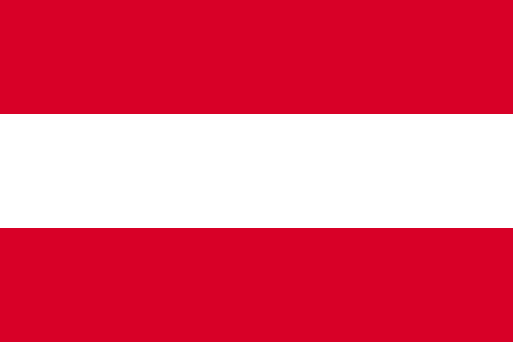
Hire in Austria
Embark on your journey with human resources best practices and the hiring process in Austria.

Austrian Currency
Euro (EUR)

The Capital of Austria
Vienna
Time Zone in Austria
GMT+1
Important Facts About the Country of Austria
Introduction to Austria
Austria operates as a parliamentary representative democracy, where both the federal president (head of state) and the chancellor (head of the federal government) are directly elected. Austria consistently holds a position in the top 20 countries worldwide for wealth measured by GDP and boasts high standards of living according to various indices. Vienna, the capital, is consistently recognized in global rankings for its exceptional quality of life indicators.
What to Know about Austria’s Geography
Situated in the southern part of Central Europe, Austria is a landlocked country primarily characterized by its mountainous terrain in the East Alpine region. Encompassing an area of around 84,000 square km and hosting a population of just under 9 million people, Austria shares its borders with Germany and the Czech Republic to the north, Slovakia and Hungary to the east, Slovenia and Italy to the south, and Switzerland and Liechtenstein to the west.
Climate in Austria
The Alps cover almost three-quarters of Austria, leading to a predominant Alpine climate. In the eastern regions, a more continental climate prevails, characterized by lower rainfall compared to the Alpine areas. Austria encounters harsh, cold winters, while summers tend to be warm, albeit cooler at elevated altitudes in the country’s mountainous regions.
The Culture of Austria
In the 18th and 19th centuries, Austria held a significant position as a European power, leaving a lasting cultural impact on the continent. Being the birthplace of numerous renowned composers, the country was recognized as the global hub for musical innovation. Additionally, Austria is celebrated for its winter sports offerings, with the Alpine tourism sector playing a crucial role in contributing to the economy.
Religions Observed in Austria
As of 2018, slightly below 60% of the population is affiliated with the Roman Catholic Church, but the percentage of regular church attendees is less than 10%. Around 12% of the population identifies as having no religious affiliation.
Languages Spoken in Austria
Formal contexts typically employ Standard German, while in schools and educational settings, Standard Austrian German, which is largely identical, is utilized. Many local German dialects, with Austro-Bavarian being the most notable, are commonly spoken and understood throughout a significant portion of the Austrian population.
Austrian Human Resources at a Glance
Employment Law Protections in Austria
Several federal statutes regulate employment relations in Austria, including the Employees Act, Contract Law Adjustment Act, and the Labor Constitution Act, with labor regulations also outlined in the General Civil Code.
Key sources of employment law encompass various statutory regulations governing all aspects of labor and employment law in Austria, including:
- The Salaried Employees Act (Angestelltengesetz) for white-collar workers.
- The Working Time Act (Arbeitszeitgesetz) for regulations on working hours.
- The Holiday Act (Urlaubsgesetz) for provisions on paid leave.
- The Labour Protection Act (Arbeitnehmerschutzgesetz) for ensuring workplace safety.
Additionally, employment contracts are subject to collective bargaining agreements (CBAs), covering over 95% of all employment relationships in Austria. Membership in a trade union is not mandatory for coverage by a CBA, and opting out of such agreements is not permissible. While employment law safeguards all dependent workers in Austria, certain regulations may not apply to managerial personnel within an organization.
Employment Contracts in Austria
A contract of employment can be provided in written, oral, or implicit form, where an implicit contract may arise through the commencement of work activity with subsequent payment.
In the absence of a written employment contract, statutory law mandates employers to furnish workers with a written statement of the terms and conditions, known as “Dienstzettel,” immediately upon the start of the employment relationship. Although it does not require the employee’s signature, a Dienstzettel must include the following details:
- Name and address of the employer.
- Name and address of the employee.
- Commencement date of the employment relationship.
- Usual place of work.
- Any classification in a general system.
- Intended assignment or job title.
- Basic salary.
- Additional emoluments (e.g., bonuses).
- Date of payment.
- Annual leave entitlement.
- Contractual normal daily and weekly working hours.
- Applicable collective bargaining agreement (CBA).
- Period and term of notice.
- End date of the employment relationship (if fixed-term).
Employment contracts imply abstract terms, including the employer’s duty of care to the employee and the employee’s duty to be faithful to the employer.
Any modification to an employment contract must not provide less favorable conditions to employees compared to the provisions of existing legislation, collective agreements, or works agreements.
Austria's Contract Terms
The traditional contract of employment remains the prevailing form in permanent employment relationships, encompassing all corresponding rights (such as leave entitlement, protection against dismissal, social insurances, etc.) and obligations.
Those under fixed-term employment contracts adhere to the same labor legislation rules as permanent employees. They benefit from equivalent insurance protection, although the absence of notice periods is notable, as the employment relationship concludes upon the expiration of the contract.
Austria's Guidelines Regarding Probation Period/Trial Period
In Austria, the probationary period is capped at a maximum of one month. Within this timeframe, the employment relationship can be terminated at any point without the need for explicit reasons and without being bound by specific terms or dates. Legal regulations prescribe a one-month limit for probationary periods in employment relationships.
Regulations and Rules Regarding Working Hours in Austria
According to Austrian law, the standard working schedule comprises eight hours per day and 40 hours per week. However, numerous industries have implemented collective agreements that reduce the daily or weekly working hours.
If the working-hour limits outlined in a Collective Bargaining Agreement (CBA) are surpassed, it is termed additional hours (Mehrstunden). When exceeding the legally stipulated limit, it is referred to as overtime (Überstunden).
Executives, individuals tasked with significant managerial responsibilities within an organization, are exempt from the provisions of the work statute on working time (Arbeitszeitgesetz).
Austrian Laws Regarding Overtime
There are specific maximum limits in place, allowing for a maximum of 12 hours per day and 60 hours per week. Additionally, there is an average weekly limit of 48 hours over a 17-week period.
Employers are legally obliged to remunerate overtime, but individual agreements for an all-in salary are feasible, contingent on the employee’s individual status. In the case of all-in salaries, employers must specify the portion designated for regular working hours (base salary) and the amount considered as compensation for overtime.
As per the Working Time Act, overtime should be compensated with either a financial bonus or time credit. This compensation is mandated to be calculated at a rate of a 50% bonus or 1.5 hours of time credit for each hour worked.
Health and Safety in the Workplace
The responsibility for ensuring health and safety at the workplace in Austria lies with the employer. If needed, they are required to enlist the services of a health and safety expert and an occupational physician. Additionally, the works council must be consulted and informed about health and safety matters. In workplaces, excluding the smallest ones, it is mandatory to appoint dedicated health and safety representatives.
Rules Regarding Bonus and 13th Month Pay in Austria
Apart from their regular monthly salary, employers in Austria may choose to grant employees a holiday bonus, commonly referred to as the 13th and 14th month paycheck or holiday money. These additional payments are typically disbursed in June and November if stipulated in the Collective Bargaining Agreement (CBA) or employment contract.
In Austria, it is customary to acknowledge employees with discretionary bonus payments. Discretionary bonuses are subject to the employer’s discretion and can be retracted at any time. Employees do not have a legal claim to these bonuses, provided the employer explicitly states that the payment is discretionary and refrains from specifying target amounts or establishing a bonus scheme (‘betriebliche Übung’).
Within the banking sector, bonuses are restricted in cases where the bank incurs a loss or accepts government assistance.
Certain Collective Bargaining Agreements permit the provision of loyalty bonuses for employees with an extensive period of service, often set at 20 years.
Termination
Ordinary terminations (Kündigungen) in Austria generally do not necessitate justification; however, employers must adhere to specified notice periods and termination dates.
Employees benefitting from “general protection against dismissals,” applicable when an organization employs five or more workers, can challenge dismissals resulting in adverse personal effects. In such cases, employers must justify dismissals based on the employee’s capabilities, conduct, or operational requirements.
“Special protection against dismissal” is afforded to certain vulnerable groups, such as pregnant women, parents on parental leave, works council members, and formally classified disabled persons. Dismissals of these employees typically require permission from the labor court or equal treatment commission.
Employees have the right to challenge discriminatory or unlawfully motivated dismissals.
Dismissals, unless specified otherwise in a Collective Bargaining Agreement (CBA) or employment contract, do not have a prescribed form, though written notice is recommended. Works councils, if present, must be informed at least one week before any proposed dismissals, with the council having the opportunity to object, approve, or refrain from commenting.
For collective dismissals (Massenkündigungen), employers must notify the Austrian Employment Service 30 days in advance. Collective dismissals involve specific thresholds based on the size of the workforce, and failure to comply renders intended dismissals void. Redundancy programs must be collaboratively implemented with the works council.
Summary dismissals (Entlassung) require no specific notice periods but must be issued promptly. Valid reasons, such as disloyalty or refusal to fulfill contractual duties, are necessary for summary dismissals, which are effective even without meeting certain requirements but may be subject to legal scrutiny.
Austria's Requirements Regarding Notice Periods
For the Employer:
White-collar workers follow specific deadlines and dates outlined in the Employees Act (AngG § 20) regarding the notice period.
Termination of employment contracts for white-collar workers can occur at the end of each quarter (31 March, 30 June, 30 September, 31 December), unless otherwise specified in the individual work contract or a Collective Bargaining Agreement (CBA).
The notice period for white-collar workers is as follows:
- Six weeks if the employment lasted up to two years.
- Two months if the employment lasted two to five years.
- Three months if the employment lasted five to 15 years.
- Four months if the employment lasted 15 to 25 years.
- Five months if the employment lasted more than 25 years.
These terms are subject to modification, but no notice period can exceed six months.
Probation Period: During the probation period, termination of a contract of employment can occur verbally by either the company or the employee without providing reasons.
Fixed-term Contract: Employment concludes automatically when the fixed-term of the contract expires, with the final day specified within the employment contract or Dienstzettel.
Termination by Mutual Consent: When both an employee and an employer mutually end an employment relationship, no notice period is required. The agreement may be terminated verbally or in writing, though written termination is recommended.
For the Employee:
Employees wishing to terminate an employment agreement must provide one month’s notice to the end of every month, unless otherwise agreed. In such cases, there is no mandatory payment in lieu of notice. Garden leave is common for senior employees, contingent upon the terms outlined in the contract regarding an employer’s right to place an employee on garden leave.
Redundancy/Severance Pay in Austria
Every private sector employee, whose employment contract extends beyond one month, has the right to receive severance pay upon termination of the employment relationship, contingent upon a minimum of three years of uninterrupted work.
For employment relationships lasting more than one month, the employer is obligated to contribute 1.53% of the monthly pay to an employee provision fund (Mitarbeitervorsorgekasse), starting from the first day of the employment relationship. However, no contributions are required for the initial month.
The selection of the fund must be based on a company agreement between the employer and the works council.
Upon termination of the employment contract, the employee is entitled to severance payment from the fund, except under the following circumstances:
- The termination was initiated by the demand of the employee.
- The termination came into effect due to wrongful behavior by the employee.
- Contributions have been paid into the fund for less than three years.
To access the severance payment, the employee must inform the fund in writing within six months of the employment contract termination. The severance payment amount is calculated based on the accumulated contributions by the end of the month when the entitlement becomes due.
Alternatively, the employee can choose to leave the money in the fund for future use, with the contribution periods from different employers aggregated. This also applies in cases of employee resignation and for those engaged in short-term employment lasting less than three years.
No additional severance pay is required by the employer. However, social plans may include special provisions for severance pay.
Post-Termination Restraints / Restrictive Covenants
Clauses designed to restrict the activities of an employee post-employment are permissible, provided they are reasonable and intended to safeguard the legitimate business interests of the employer. To be enforceable:
- The restriction must directly pertain to the individual’s activities within the employer’s business.
- The maximum duration of the clause should not exceed one year following the termination of employment.
- The employee’s monthly income at the termination of the employment relationship must surpass a certain amount (currently set at EUR 3,580).
- The restriction should not unduly hinder the professional progress of the individual.
- The employer is not obligated to compensate the employee during the prohibition period, and contractual penalties are capped at six net monthly remunerations, excluding the 13th and 14th annual salary.
Non-competes
Non-competes are permissible for certain employees with higher income levels but are limited to a duration of 12 months. If valid and enforceable, the employer is not required to provide compensation during the non-competition period. The validity depends on factors such as whether the employee or employer initiated the termination of employment.
If the non-compete clause is not enforceable (e.g., if the employer terminates employment without good reason), the employer may need to pay the salary during the non-competition period to make the clause enforceable.
Customer non-solicitation clauses are allowed in specific circumstances, while employee non-solicitation clauses are generally permissible.
Austrian Timesheets
In 2019, the European Court of Justice ruled that companies must establish a system for recording the working hours of their employees. Consequently, employers are required to introduce an objective, reliable, and easily accessible system to track the working hours completed by each employee.
Trade Unions / Collective Agreements in Austria
Trade unions have a rich history and wield significant political influence in Austria. The Österreichischer Gewerkschaftsbund (ÖGB), the singular trade union confederation, boasts a membership of 27% of all employees. Although not aligned with any specific party, the ÖGB maintains robust political connections through its network of political affiliations.
Individual trade unions align themselves with the ÖGB, with additional regional organizations in place. The trade unions collectively represent approximately 1.2 million members in Austria. Membership is occupation-based, tied to specific industries.
Trade unions play a pivotal role in advocating for the political, economic, and social interests of employees concerning companies, government, and political entities. Their responsibilities encompass negotiating collective agreements, participating in industry-wide decision-making within the economic and social partnership framework, implementing social enhancements, upholding social standards, safeguarding real wages, and providing necessary legal consultations for members.
While strikes and lockouts are uncommon in Austria, labor disputes, including those related to wage adjustments, are typically resolved through negotiations involving representatives from trade unions and chambers of commerce.
The Chambers of Labor (Arbeiterkammer) represent around three million employees and freelance contractors nationwide, excluding senior white-collar workers and civil servants. Membership is obligatory for all employees and freelance contractors, with a contribution (Arbeiterkammerumlage) amounting to 0.5% of gross income, deducted directly from salaries. Similar to the ÖGB, the Chamber of Labor advocates for the social, economic, and political interests of employees in dealings with companies, government, and political bodies.
Employees are further represented by works councils, elected by the workforce. Established when businesses consistently exceed five employees, works councils play a crucial role in liaising between employees and business owners, providing consultation and information on labor law matters such as dismissals, redundancies, and recruitment.
Fixed Term Contacts for Austrian Employees
In Austria, there is no set restriction on the duration of fixed-term contracts or a specific timeframe after which the employee automatically becomes a permanent employee. However, a sequence of successive fixed-term contracts, known as “Kettenarbeitsverträge,” can lead to the establishment of an indefinite employment relationship. It is noteworthy that terminating an indefinite employment contract is generally more straightforward, while terminating a temporary contract before its agreed-upon term requires specific grounds.
Tax and Social Security Information for Employers in Austria
Personal Income Tax in Austria
The Income Tax Act (Einkommenssteuergesetz) governs taxation in Austria. Earnings from employment are subject to a progressive income tax scale ranging from 0% to 55%. The applicable tax rate is determined by the taxable income earned within a calendar year, aligning with the business year’s 12-month period.
Employers deduct wage tax, or Lohnsteuer, directly from salaries at the source (Quellensteuer), along with social insurance contributions. This withheld tax, along with social insurance contributions, is then remitted by the employer to the relevant authorities. It’s essential to note that the deducted tax serves as a preliminary payment towards the annual tax liability. The final settlement occurs during the annual tax assessment (Arbeitnehmerveranlagung) for employed individuals.
To ease the tax burden, various deductible amounts are available, depending on individual circumstances. These deductions include allowances such as the sole breadwinner’s allowance, single parent’s allowance, and various lump sums, as well as special expenses like the family bonus, commuter allowance, and extraordinary costs such as hospital charges.
| Income Band (EUR) | Tax Rate % |
|---|---|
| Up to 11,693 | 0.0 |
| 11,694-19,134 | 20.0 |
| 19,135-32,075 | 30.0 |
| 32,076-62,080 | 41.0 |
| 62,081-93,120 | 48.0 |
| 93,121-1 million | 50.0 |
| >1 million | 55.0 |
Social Security in Austria
Both employees and employers are obligated to make social insurance contributions, with the exception of accident insurance, which is solely the responsibility of employers.
Austria mandates comprehensive social insurance covering health, pension, unemployment, and accident insurance. This compulsory system ensures a broad range of coverage for individuals.
Regular social insurance contributions are calculated based on a maximum contribution basis of EUR 5,850 per month. For special payments that do not recur monthly, such as bonuses, the maximum contribution base is set at EUR 11,100 annually.
| Type of Insurance | Paid by Employer (%) | Paid by Employee (%) | Total |
|---|---|---|---|
| Pension insurance | 12.55 | 10.25 | 22.80 |
| Accident insurance | 1.10 | 0.00 | 1.10 |
| Health insurance | 3.78 | 3.87 | 7.65 |
| Unemployment insurance | 3.00 | 3.00 | 6.00 |
| Others | 0.6 | 1.00 | 1.6 |
| Total | 21.03 | 18.12 | 39.15 |
| Severance fund | 1.53 | 0.00 | 1.53 |
| Family burden compensation fund | 3.9 | 0.00 | 3.9 |
* Employees also contribute minor amounts for housing purposes. This includes an additional 1% housing subsidy share directed towards a dedicated fund designed to safeguard wages and salaries in case of unforeseen circumstances, such as insolvency. Furthermore, employees allocate 0.5% of their gross earnings to the Chamber of Labour contribution. Additionally, employees may incur trade union dues and church tax, which are deducted directly from their pay.
** Employers are required to contribute 1.53% of the gross salary to a severance payment fund (Mitarbeitervorsorgekasse). This mandatory contribution is applicable to all private law employment contracts established on or after January 1, 2003.
*** The provided table serves as a general reference. Actual rates applied by GoGlobal may vary.
Important Information for Austrian Employees
Salary Payment
- In most instances, remuneration is deposited into a salary account either on the final day of the month or the initial day of the subsequent working month.
- According to legal requirements, salaries are disbursed 14 times a year. Typically, the 13th salary is dispensed at the conclusion of June, known as the “holiday bonus,” while the 14th is distributed at the close of November, recognized as the “Christmas bonus.” Employees benefit from a reduced tax rate (6%) for both the 13th and 14th salaries.
- Taxes, social insurance contributions, and other deductions, such as union contributions, are subtracted from the employee’s gross earnings by the employer. Subsequently, these amounts are remitted to the relevant institutions, including the finance office and social insurance institution.
Payslip
Upon receiving their monthly compensation, employees are required to be provided with a written remuneration statement. This payslip meticulously outlines deductions, encompassing taxes, social insurance, mandatory contributions, and voluntary deductions like trade union dues and church taxes.
In the event of an employee departing from the organization, a conclusive statement must be furnished, outlining any applicable severance entitlements.
Annual Leave
As per the Holidays Act, employees are entitled to a minimum of five weeks of paid annual leave each year. When calculating leave based on working days, which include Saturdays, employees have a yearly entitlement of 30 days. This entitlement increases to six weeks after completing 25 years of service.
The working year begins on the employee’s job start date. During the initial six months, holiday time accrues proportionally, approximately two days per month. Starting from the seventh month, employees receive the full leave entitlement. From the second year onward, the full leave entitlement begins accruing at the start of the working year.
Agreement with the employer is necessary for determining when an employee can take their leave. Employer consent is required.
In case of illness lasting more than three calendar days during annual leave, those days are not counted as leave. However, the employee must promptly report the illness to the employer after three days of absence and provide a medical certificate.
Regarding carry-over rules, unused leave can be carried over, but it expires if not used within two years from the year of accrual. Any annual leave taken is deducted from the employee’s oldest entitlement.
Sick Leave
The principle of continued remuneration ensures that, in the event of sickness, industrial accidents, occupational illnesses, and during rest cure and convalescence leave, employees will continue to receive their remuneration. The Sick Pay Act (Entgeltfortzahlungsgesetz) (EFZG) stipulates sick leave entitlements based on the employee’s length of service:
- In the first year of employment: 6 weeks
- Two to 15 years: 8 weeks
- 16 to 25 years: 10 weeks
- From the 26th year: 12 weeks
After the period of paid sick leave, the employee is entitled to an additional four weeks on half-pay.
Once the paid sick leave from the employer is exhausted, the Health Insurance System provides partial pay for a maximum of 52 weeks. The amount of sick pay depends on the earnings in the last month before the illness and the remuneration continued by the employer. The employee is obligated to promptly inform the employer when they become incapacitated for work.
Other Rights for Leave of Absence
Care Leave
Employees have the right to take unpaid time off or work part-time for the care of sick relatives without requiring the employer’s consent. During care leave, employees are eligible to receive a state-funded care leave allowance, and key details regarding care leave include:
- Care leave is applicable only for the care of close relatives, such as a spouse or children.
- The rules apply to establishments with more than five employees.
- Employees need to be employed for at least three months to become eligible for care leave.
- To initiate care leave, an employee must inform their employer of the intended start date, with no specific formal notification requirements outlined by the law. The employer may request proof of the need for care leave and evidence of the relationship to the person being cared for.
Initially, employees can request up to two weeks of care leave or part-time care leave, extendable unilaterally for up to four weeks. With the employer’s consent, an employee can extend care leave or part-time care leave to a maximum of six months.
While care leave or part-time care leave doesn’t provide special protection against termination, if an employee can demonstrate that dismissal was related to their care leave request, the dismissal may be challenged on the grounds of bad motive.
Education leave
Educational or study leave can be arranged at the employer’s discretion after six months of continuous employment. The duration of this leave can range from a minimum of two months to a maximum of one year. If taken in multiple periods, each period should last a minimum of two months. The study leave can be spread over four years in individual periods. During this time, the employee won’t receive a salary, but they are entitled to an additional training allowance (Weiterbildungsgeld) from the Employment Service (AMS) equivalent to their eligible unemployment benefit. The employee is required to engage in a training program for a minimum of 20 hours per week.
Compassionate & Bereavement Leave
Employees have the right to avail compassionate leave to attend to the needs of severely ill children or be with dying relatives. During such situations, employees may adjust or reduce their working hours as necessary.
Maternity & Parental Leave
Maternity Leave
- The protection period (Mutterschutz) for expectant employees typically commences eight weeks before childbirth and concludes eight weeks thereafter, during which absolute employment prohibition applies.
- Throughout this period, the employment relationship persists, and the employee is entitled to a maternity allowance (Wochengeld) equivalent to the average remuneration over the last 13 weeks before the commencement of absolute employment prohibition.
- In cases of caesarean or multiple births, the post-delivery work restrictions extend to a minimum of 12 weeks.
- If an employee’s maternity leave was shortened before delivery, the work restriction period extends accordingly, with a maximum of 16 weeks.
Parental Leave
Austrian law permits parents to take a minimum of three months of unpaid parental leave between a child’s birth and their second birthday. Up to one month can be taken concurrently, with either parent utilizing the remaining leave. Parents with an annual salary below a specified threshold may be eligible for a government-funded childcare allowance (Kinderbetreuungsgeld).
Paternity Leave
- According to the Paternity Leave Act, fathers are entitled to one month of leave, known as the “Daddy Month” (Papa Monat), following their child’s birth.
- The employee can request leave during the period between the child’s birth and the end of the mother’s employment prohibition.
- This applies if the father resides in the same household as the child.
- No minimum years of service are required for paternity leave, and the employer is not responsible for remuneration during this period.
- Paternity leave can start the day after the child’s birth, and if the mother is unable to care for the child, the employee can transition directly to parental leave.
Adoption Leave
Adoptive parents in Austria are entitled to parental leave, and general paternity leave is extended to fathers of adopted and foster children under two years of age.
Childcare Leave
Mothers have the option to reduce their working hours from full-time to part-time until their child’s seventh birthday or until the child starts school, whichever comes later. This is permissible for those who have been continuously employed by a business with over 20 employees for at least three years.
Public Holidays
Austria observes 13 official public holidays, during which employees are eligible for paid time off. Public holiday rest entails a continuous 24-hour break, commencing no earlier than midnight on the public holiday and concluding no later than 6:00 a.m. on the same day.
Benefits to the Employee in Austria
Austrian Statutory Benefits
The Austrian social security system encompasses various aspects, including coverage for:
- Sickness
- Incapacity for work/invalidity
- Maternity
- Unemployment
- Old age
- Death of an individual responsible for providing maintenance
- Survivors’ pensions
- Nursing care
- Social assistance
Employees holding an employment contract and a statement of terms and conditions (Dienstzettel) are automatically enrolled in the social insurance system. Employers bear the responsibility of registering employees with the relevant insurance institutions and are obligated to deduct monthly insurance contributions from the gross wages of the employees.
Other Benefits
Supplementary employee benefits are commonly extended to senior and executive-level personnel, encompassing:
- Supplementary pension benefits tailored for managers
- Enhanced healthcare coverage for managers
- Provision of company cars and transportation allowances for managerial staff
Rules Regarding Visas and Foreign Workers in Austria
General Information
Visa
EU/EEA citizens, Swiss nationals, and their families enjoy visa-free entry and residence in Austria, subject to the following conditions:
- They are permitted to stay in Austria for a maximum of three months without any additional formalities.
- For an extended stay, they are required to demonstrate possession of health insurance and adequate financial resources to support themselves and their family members. Additionally, proof of employment, self-employment, or participation in training in Austria is necessary.
- Within four months of their arrival in Austria, they must register with the competent authorities (Aufenthaltsbehörde), resulting in the issuance of a ‘right of residence document’ (Anmeldebescheinigung).
- Furthermore, citizens of EU/EEA countries have the option to apply for an official photo identification for EEA citizens (Lichtbildausweis für EWR-Bürger). This identification is issued by the competent district authority (Bezirkshauptmannschaft) or the relevant department of the town or city authority (Magistratsabteilung).
- Special provisions are in place for ‘privileged third-country nationals,’ which include dependents of nationals from EU/EEA countries and Switzerland who themselves do not possess EU/EEA/Swiss citizenship.
Individuals who are not citizens of the EEA or Switzerland, commonly referred to as third-country nationals, are required to obtain a visa.
- The Red-White-Red Card, valid for 24 months, grants individuals specific rights, including temporary settlement and employment with the employer indicated in their application. Eligibility for a Red-White-Red Card is based on belonging to one of the following categories:
- Very highly qualified workers
- Skilled workers in shortage occupations
- Other key workers
- Graduates of Austrian universities and colleges of higher education
- Self-employed key workers
- Startup founders
For stays exceeding 90 days but not surpassing six months, a temporary residence visa is mandatory. This visa allows the holder to engage in gainful employment during their visit. In exceptional circumstances, these visas may be valid for up to 12 months, often based on international agreements. Extensions are possible, contingent on newly arising circumstances since the visa issuance, and applications must be substantiated with valid reasons such as force majeure, humanitarian grounds, or significant occupational or personal factors.
Short-term stays for business purposes necessitate a Schengen visa. This authorizes one or more consecutive stays, not exceeding a cumulative total of 90 days within any 180-day period.
The EU Blue Card provides highly-qualified non-EU workers the privilege to reside and work in an EU country, contingent on possessing advanced professional qualifications, including a university degree, an employment contract, or a job offer with a salary above the EU country’s average.
For visits within 90 days within a 180-day period, some third-country nationals may not require a visa, depending on their citizenship.
General requirements for issuing residence permits mandate that authorities can only grant a residence title if individuals meet specified criteria.
- Sufficient means of financial support
- Coverage under health insurance (being enrolled in the public social insurance system as an employee in Austria is considered satisfactory)
- Appropriate housing
- No risk to public order or security
Work Permits
Citizens from the European Economic Area (EEA) and Switzerland possess the right to work in Austria, with the exception of Croatia. However, non-Austrian nationals, apart from those within the EEA or Switzerland, must obtain immigration permission and a work permit.
Typically, employers are obligated to seek work permits for each foreign national they intend to hire, in accordance with section four of the Employment of Aliens Act (Ausländerbeschäftigungsgesetz) (AuslBG). Nevertheless, numerous exceptions exist to this rule. For instance, work permits are unnecessary for:
- Individuals holding permanent residence permits, such as third-country nationals who have lawfully and continuously resided in Austria for the last five years, are eligible to receive a “Long-term resident-EU” (Daueraufenthalt-EU) residence permit.
- This applies to EEA nationals,
- spouses of Austrian citizens, and
- individuals from countries with existing intergovernmental agreements.
Getting a Tax Number
Like many EU nations, Austria assigns a tax identification number (TIN) to all resident individuals who have tax obligations. The TIN, a nine-digit identifier, is essential for income tax processing and can be acquired through the local tax office.
Public Holidays Recognized by Austria in 2024
| Occasion | Date | |
|---|---|---|
| 1 | New Year’s Day | January 1 |
| 2 | Epiphany | January 6 |
| 3 | Easter Monday | April 1 |
| 4 | Labour Day | May 1 |
| 5 | Ascension Day | May 9 |
| 6 | Whit Monday | May 20 |
| 7 | Corpus Christi Day | May 30 |
| 8 | Assumption Day | August 15 |
| 9 | National Day | October 26 |
| 10 | All Saints’ Day | November 1 |
| 11 | Immaculate Conception Day | December 8 |
| 12 | Christmas Day | December 25 |
| 13 | Saint Stephen’s Day | December 26 |
Hire New Talent in Austria
Our global hiring services enable you to onboard personnel in any country without the financial commitment required to establish a local entity.