
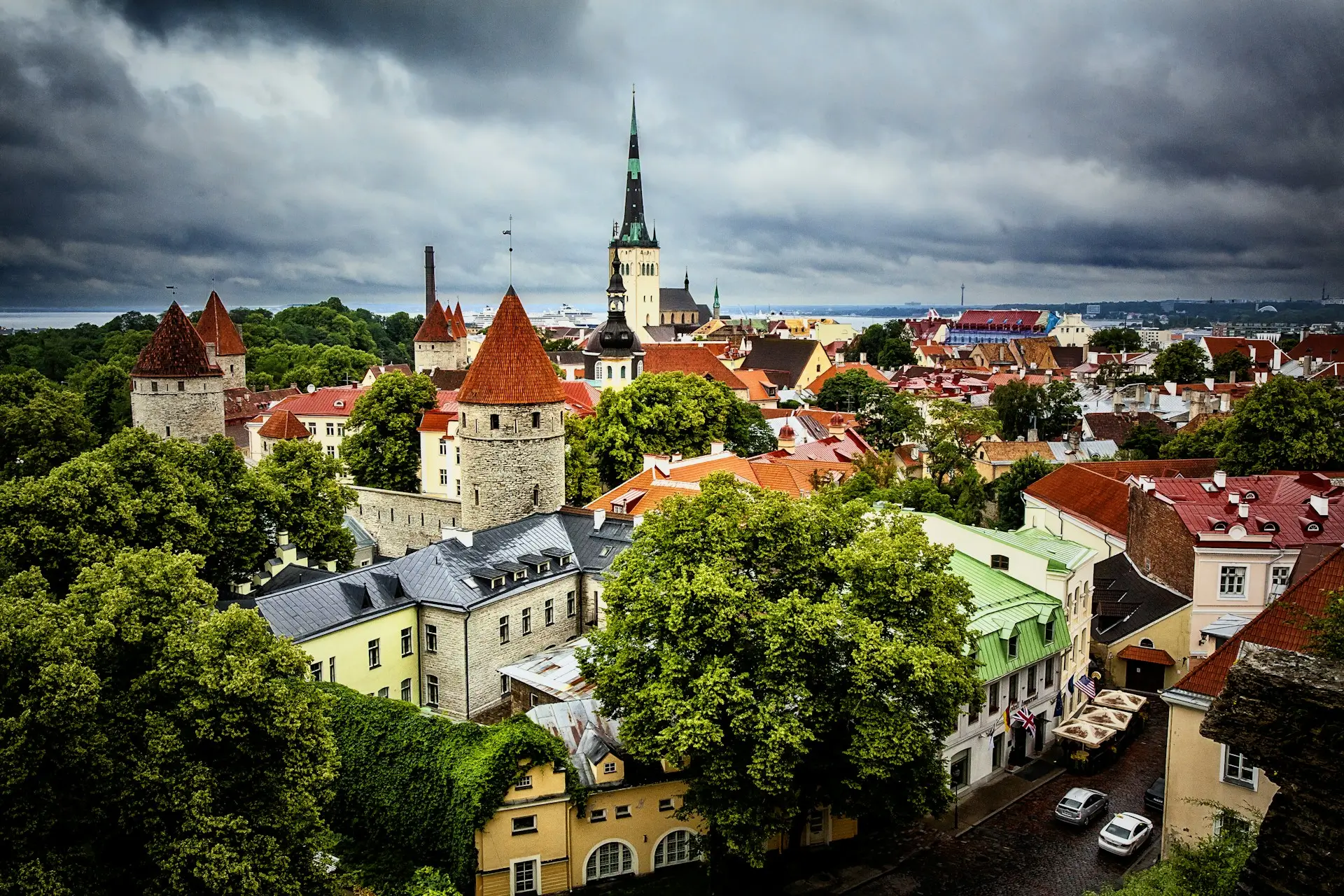

Hire in Estonia
Begin your journey into human resources best practices and the hiring process in Estonia here.

Estonian Currency
Euro (EUR)

The Capital of Estonia
Tallinn
Time Zone in Estonia
GMT+2
Important Facts About the Country of Estonia
Introduction to Estonia
Estonia, situated in Northeastern Europe, stands as the northernmost among the three Baltic nations. It operates as a democratic unitary parliamentary republic with a thriving economy, experiencing rapid growth since its EU accession in 2004. The population of Estonia exceeds 1.3 million people.
What to Know about Estonia’s Geography
Estonia shares its eastern boundary with Russia and its southern edge with Latvia. It is encircled by the Baltic Sea on the west and north sides. The country’s geography encompasses the mainland and over 2,000 minor islands, spanning a collective area of around 45,000 square kilometers.
Climate in Estonia
Estonia enjoys a temperate climate zone, which varies significantly from the inland regions to the east at the same latitude. The country experiences four distinct seasons of roughly equal length, characterized by relatively mild winters and summers.
The Culture of Estonia
Due to its geographical location, Estonia has historically been shaped by the cultural influences of both Eastern and Western Europe, particularly from its prominent neighbors, Russia and Sweden. In contemporary times, Estonian society is recognized for its liberal values, emphasis on individual freedoms, and a robust work ethic.
Religions Observed in Estonia
The Estonian constitution ensures the separation of church and state. Recent surveys indicate that almost 75% of the population claims no religious ties. Among those who do identify with a religion, Christianity predominates.
Languages Spoken in Estonia
Estonian is the official language of Estonia, with Russian being the most commonly spoken language among minorities. Many younger Estonians are proficient in English, and English, German, and Russian are commonly taught as second languages.
Estonian Human Resources at a Glance
Employment Law Protections in Estonia
In Estonia, the relationship between employers and employees is primarily governed by the Employment Contracts Act (Töölepingu Seadus). Additional regulations come from the Law of Obligations Act (Võlaõigusseadus), the Individual Labor Dispute Resolution Act (Individuaalse töövaidluse lahendamise seadus), and the Occupational Health and Safety Act (Töötervishoiu ja tööohutuse seadus).
Estonian labor laws are generally more flexible, but they are designed to protect employees. This means that any contract terms that are less favorable to employees than the rights provided by law are likely to be deemed invalid.
Employment Contracts in Estonia
An employment contract is required to be in written form. Nonetheless, a contract is also recognized when work is performed in exchange for pay.
Terms in an agreement that disadvantage an employee, especially those dependent on a variable outcome (resolutive condition), are null and void. Changes to an employment contract must be mutually agreed upon by both parties.
The written employment contract must at minimum include:
- Names, identification or registration numbers, and addresses of both employer and employee
- Start date of the contract and the commencement date for the employee
- Detailed job responsibilities
- Job title
- Details of compensation, including amount, payment process, and schedule
- Information on taxes and deductions managed by the employer
- Additional benefits, if any
- Working hours
- Work location
- Vacation policy
- Notice period for termination
- Mention of the employer’s work regulations
- Reference to any applicable collective bargaining agreements
The employer is obliged to retain the written contract for the duration of its validity and for ten years after its termination.
Estonia's Contract Terms
An employment agreement in Estonia is generally considered open-ended. However, a fixed-term contract, not exceeding five years, may be established based on justifiable reasons related to the temporary nature of the work. This is particularly relevant when there is a transient surge in workload or the nature of the work is seasonal.
If a fixed-term contract is renewed more than twice consecutively or extended beyond one time within a five-year period, it will be considered open-ended from the beginning. Sequential fixed-term contracts are regarded as consecutive if the interval between the conclusion of one contract and the initiation of the subsequent contract does not surpass two months.
Estonia's Guidelines Regarding Probation Period/Trial Period
In Estonian labor contracts with an indefinite duration, the trial period should not surpass four months. For temporary contracts, the trial period must not exceed half of the contract’s total duration. A written notice of 15 days is required during the trial period.
Regulations and Rules Regarding Working Hours in Estonia
A standard assumption is that a full-time employee dedicates 40 hours to work over a seven-day period, with eight hours per day. Flexibility in applying a condensed working time calculation within a specified period of up to four months is available. Overtime is typically sanctioned through mutual agreement, but certain constraints apply.
The average working time should not exceed 48 hours over a seven-day period during a calculation span of up to four months, unless otherwise stipulated by law for a different calculation period.
Any agreement granting an employee less than 11 consecutive hours of rest within a 24-hour period is void, unless mandated by law. Similarly, an agreement providing less than 48 consecutive hours of rest over a seven-day period is void unless otherwise prescribed by law. The presumption is that an employee’s weekly rest time occurs on Saturday and Sunday.
In a departure from standard working time regulations, employers and full-time employees engaged in ensuring the continuous operation of information and communication technology services, infrastructure, and information security may enter an agreement waiving daily and weekly rest times. This agreement, documented in writing, should not exceed 130 hours of on-call time per month, permit remote activities with a reasonable response time, and ensure the employee two free weekends monthly. The agreement must not compromise the employee’s health or safety and can be terminated with 30 days’ notice.
Estonian Laws Regarding Overtime
Employers and employees may mutually agree for the employee to engage in work beyond the established working schedule, commonly referred to as overtime work. In the context of calculating summarized working time, overtime work encompasses any hours worked beyond the agreed-upon working time.
Employees working in hazardous conditions, with their working time shortened due to these conditions, are not eligible for overtime work.
Aligned with the principle of good faith, employers in Estonia have the right to request employees to work overtime in unforeseen circumstances. These circumstances should be directly related to the enterprise or activity of the employer and aimed at preventing loss or damage.
Minors, pregnant women, or employees with the right to pregnancy and maternity leave cannot be compelled to work overtime by their employers.
Compensation for overtime work typically involves granting the employee equivalent time off unless a prior agreement exists for financial compensation. When compensating for overtime with monetary means, employers are obligated to pay employees 1.5 times their regular wages. If the overtime work coincides with a public holiday, the employer must remunerate the employee at a rate of two times their ordinary wages.
Health and Safety in the Workplace
An evaluation of an employee’s health and the compatibility of their working environment and organization necessitates a mandatory medical examination.
Within the initial four months of the employee’s commencement of employment, the employer is responsible for coordinating the required medical examination.
The occupational health doctor communicates the findings of the health examination to the employee and issues a decision based on the medical assessment.
Rules Regarding Bonus and 13th Month Pay in Estonia
In certain industries in Estonia, it is a prevalent practice for companies to grant bonuses to employees upon the achievement of specific agreed-upon targets during designated reference periods. These time frames commonly span monthly, quarterly, or yearly durations. The criteria and computation for these bonuses are typically outlined in a written bonus plan. Additionally, employers have the option to establish a collective bonus system tied to a set of predetermined company objectives for the collective benefit of their employees.
Termination
The following terms govern the ‘ordinary’ termination of employment contracts in Estonia:
- A cancellation is presumed to be ordinary unless the employee proves it to be ‘extraordinary.’
- An employer may not ordinarily cancel an employment contract.
- An employee in an indefinite-term contract can ordinarily cancel their employment contract at any time.
- An employee may not ordinarily cancel a fixed-term contract.
For the ‘extraordinary’ termination of employment contracts in Estonia:
1. The employer must cancel an employment contract within a reasonable time after learning (or should have learned) of the circumstances justifying the cancellation.
2. An employer may extraordinarily cancel an employment contract with good reason and by adhering to advance notice terms in the following cases:
-requiring alternative work offer before termi Prolonged inability to perform duties due to health reasons, presumed after a period exceeding four months. Before termination, the employer must offer alternative work unless it incurs disproportionately high costs.
– Prolonged inability to perform duties due to insufficient skills, non-suitability, or inadaptability, nation unless it incurs disproportionately high costs.
– Disregard for reasonable instructions, breach of duties despite a warning, working while intoxicated despite a warning, theft, fraud, loss of employer’s trust, significant property damage, violation of confidentiality or trade restriction.
3. An employer may extraordinarily cancel an employment contract for economic reasons, such as decreased work volume, reorganization, or cessation of work (layoff). Before termination, the employer must offer alternative work, with exceptions for disproportionately high costs. Priority is given to employees’ representatives and those raising children under three years during layoffs.
4. An employer may also extraordinarily cancel an employment contract for economic reasons upon business closure or bankruptcy, considering the principle of equal treatment.
Collective termination of employment contracts:
- Five employees in enterprises with up to 19 average employees
- Ten employees in enterprises with 20–99 average employees
- Ten percent of employees in enterprises with 100–299 average employees
- Thirty employees in enterprises with at least 300 average employees
Extraordinary cancellation by employee:
- An employee may cancel a contract extraordinarily with good reason if continuation is unreasonable.
- Cancellation is allowed for a fundamental breach of the employer’s obligation.
- Cancellation is permissible due to reasons arising from the employee, particularly health or family duties preventing the agreed work, provided the employer does not offer suitable work.
- An employee must cancel within a reasonable time after learning of the basis for cancellation.
Estonia's Requirements Regarding Notice Periods
The notice period an employer must provide to an employee is contingent upon the length of employment:
- For less than one year of service, the employer must give a minimum of 15 calendar days’ notice.
- With one to five years of service, the employer must provide at least 30 calendar days’ notice.
- For five to 10 years of service, the employer must give a minimum of 60 calendar days’ notice.
- With 10 years or more of service, the employer must provide the employee with at least 90 calendar days’ notice.
Employees opting to terminate their contracts must give the employer a notice period of at least 30 calendar days.
During the probationary period, employment contracts may be terminated by providing a notice period of at least 15 calendar days. An employee is not obligated to inform the employer of an extraordinary cancellation if, considering all circumstances and mutual interests, it cannot reasonably be expected for the contract to continue until the agreed-upon term or the term of advance notice.
Severance Pay in Estonia
Upon the termination of an employment contract due to a layoff, the employer is obligated to provide the employee with compensation equal to one month’s average wages. Additionally, the employee is entitled to receive an insurance benefit as per the Unemployment Insurance Act.
The severance amount is contingent on years of service:
- 5 years or less: 1 month
- 5-10 years: 2 months
- More than 10 years: 3 months
Employers have the option to compensate employees in lieu of providing notice.
In the case of terminating a fixed-term employment contract for economic reasons, the employer must compensate the employee with an amount equivalent to the salary due for the remaining duration of the contract term.
If an employee terminates the employment contract extraordinarily due to the employer committing a fundamental breach, the employer is required to pay the employee compensation equivalent to three months’ average wages.
Post-Termination Restraints / Restrictive Covenants
A post-employment restraint of trade clause is considered valid only under the following conditions:
- The clause is essential for safeguarding the employer’s specific economic interests.
- The clause is reasonably and clearly limited for the employee in terms of spatial, temporal, and objective aspects.
- The clause has been mutually agreed upon in writing.
- The clause remains in effect for a maximum of one year, commencing from the expiration of the employment contract.
- The employer provides the employee with a fair monthly compensation for adhering to the terms of the agreement.
Estonian Timesheets
In 2019, the European Court of Justice emphasized that companies are required to establish an objective, dependable, and easily accessible system for documenting the working hours of their employees.
Trade Unions in Estonia
The functioning of trade unions in Estonia is governed by the Trade Unions Act and the Collective Agreements Act. The former defines the fundamental rights and framework for the operations of trade unions, including their interactions with government authorities and employers. The latter establishes the legal foundation for the negotiation and execution of collective agreements. Employees possess the freedom to voluntarily establish, join, or abstain from joining trade unions. However, both trade union membership and prevalence have experienced a decline in recent years.
Tax and Social Security Information for Employers in Estonia
Personal Income Tax in Estonia
Both resident and non-resident taxpayers are subjected to a uniform income tax rate of 20% on employment income.
Residents are obligated to pay income tax on all income derived from sources within Estonia and globally. Additionally, residents’ employment income is subject to unemployment insurance premiums at a rate of 1.6% and mandatory funded pension contributions of 2%.
Non-residents are required to pay income tax solely on income sourced within Estonia. However, specific activities may qualify for a reduced rate of 10%. This pertains to income generated from artistic and sports activities, fees for professional services, and royalties.
Social Security in Estonia
Social Security Contributions:
In Estonia, employers are obligated to remit social tax on employee payments at a fixed rate of 33%, without any specified cap.
Unemployment Insurance Contributions:
Employers have an additional responsibility to remit and withhold unemployment insurance contributions. Employers must contribute 0.8%, and employees are required to contribute 1.6%.
It is the employer’s responsibility to compute and withhold all applicable payroll taxes on a monthly basis.
*Please note that the provided rates are general indicators, and the actual rates imposed by GoGlobal may vary.
Important Information for Estonian Employees
Salary Payment
Employers are required to remunerate employees on a monthly basis, although a more frequent payment schedule may be mutually agreed upon. In cases where the scheduled payday coincides with a public holiday or a day off, the payment will be disbursed on the working day preceding the public holiday or day off. Wages and other forms of remuneration must be transferred to the employee’s designated bank account, unless an alternative arrangement is explicitly agreed upon.
Payslip
Estonia does not impose statutory requirements for employee payslips. Nevertheless, as per the Employment Contracts Act, if requested by the employee, the employer must provide information about the monthly salary, fees, bonuses, average salary calculations, or any other relevant details associated with the employment relationship. The method of payslip disclosure, whether in paper format or via email, can be agreed upon by mutual consent between the parties.
Annual Leave
Every employee is entitled to a minimum of 28 calendar days of annual paid leave, with the exclusion of national holidays and public holidays from the calculation. The annual holiday must be utilized within the same calendar year, and its approval requires mutual agreement from both parties. A minimum of 14 consecutive calendar days of vacation is mandatory, and the employer can decline to divide the annual holiday into segments shorter than seven days.
Carry Over Regulations
Any unused portion of the holiday can be carried over to the subsequent calendar year, but it will lapse without compensation within one year from the conclusion of the calendar year for which the holiday was initially calculated.
Sick Leave
In the event of illness, the employee may be granted a maximum of 182 calendar days of paid sick leave, capped at 250 days per year. During this period, the gross wage is set at 70% of the individual’s average salary from the previous year. The employer is responsible for covering the wage from the fourth to the eighth day of sickness, while the government takes over payment from the ninth day onward.
Maternity & Parental Leave
**Maternity Leave:**
Female employees are entitled to 100 days of pregnancy and maternity leave, which can start at least 70 days before the expected birth date and extend for 30 days after childbirth. The state provides maternity benefits. It is advisable for pregnant employees to discuss their maternity leave plans with their employer at least 30 calendar days before the commencement. Maternity leave must be utilized consecutively.
If a female employee opts to begin maternity leave 30 days before the expected birth date, the leave duration will be a minimum of 60 days, leaving up to 40 days unused. These remaining days can be transferred to shared parental leave, offering flexibility for both parents.
Choosing maternity leave less than 30 days before the expected birth date results in a minimum leave duration of 30 days, with unused days not transferable to shared parental leave. Hence, it is recommended for pregnant employees to commence maternity leave at least 30 days before the anticipated birth date.
**Paternity Leave:**
Fathers are entitled to 30 calendar days of paternity leave, which can be taken as a single block or in multiple segments from 30 days before the expected birth date until the child turns three.
**Parental Leave:**
Parents can request parental leave for raising a child up to 3 years old. The state provides parental benefits, and combined maternity and parental benefits cover a period of 575 days. If a child has a disability, parents receive an additional day of leave per month until the child reaches 18.
**Adoptive Parent Leave:**
Adoptive parents of children under 10 years old are entitled to 70 calendar days of adoptive parental leave within six months from the court judgment approving adoption. Compensation can be obtained according to the Health Insurance Act, with a requirement to take at least 7 days at a time.
**Childcare Leave:**
Childcare leave is available to both employed parents on a per-child basis. Each parent can take up to 10 days of parental leave per child under 14 years old, totaling 20 days for both parents. Childcare leave remains valid until the end of the calendar year in which the child reaches 14 years old and does not expire annually.
Other Leaves
**Carer’s Leave:**
Adult employees are entitled to a maximum of five working days of leave per calendar year for providing care to an adult with a profound disability, known as carer’s leave. Eligible caregivers include the spouse or registered partner, parents, siblings, guardians, or appointed caregivers. Compensation for carer’s leave is based on the minimum wage established according to subsection 29 (5) of this Act.
Public Holidays
Estonia typically observes 12 officially recognized public holidays each year, during which normal working activities are suspended. Furthermore, it is customary for employers to reduce the working day by three hours preceding New Year’s Day, the Republic of Estonia’s anniversary, Victory Day, and Christmas Eve.
Benefits to the Employee in Estonia
Estonian Statutory Benefits
Broadly, all employees in Estonia, for whom employers have contributed social security contributions from their gross salary, are encompassed by and entitled to the advantages of the Estonian Social Insurance scheme.
The Social Insurance scheme encompasses:
- Health insurance
- Unemployment insurance
- Family benefits
- Disability and incapacity benefits
- Old age and survivor’s pension
Other Benefits
International employers in Estonia often provide additional benefits that may not be standard offerings from local companies. These can include:
- Supplementary private healthcare plans
- Extra holidays
- Company car (for salespeople and senior executives)
- Gym membership
- Remote working opportunities
- Provision of a laptop and mobile phone
Rules Regarding Visas and Foreign Workers in Estonia
General Information
EU, EEA (Iceland, Liechtenstein, and Norway), and Swiss citizens enjoy visa-free entry to Estonia. To work and stay beyond three months, they must register for Estonian residency within the initial three months of arrival.
Non-EU nationals seeking short-term employment (up to six months annually) should obtain a D-visa. Prior to the visa application, employers must register short-term employment with the Estonian Police and Border Guard Board.
For extended employment (over six months), non-EU citizens need to apply for a residence permit. Initially, they seek a temporary residence permit, renewable for up to two years. After five years on a temporary permit, they may apply for a long-term residence permit. The process involves submitting an application with identification documents, and employers must complete an “Invitation by Employer” form, submitted to the Police and Border Guard Board.
Under the EU’s Blue Card system, highly skilled non-EEA nationals can reside and work in Estonia. Employers are required to pay these employees a salary at least 1.5 times the Estonian annual average gross monthly salary during the EU Blue Card’s validity.
Getting a Tax Number
The Estonian identification code (‘Isikukood’) is a distinctive 11-digit code generated based on an individual’s gender and date of birth, facilitating precise identification. This code also serves as a Tax Identification Number. All residents and workers in Estonia are entitled to possess a personal identification code.
For citizens of the European Union, European Economic Area, or Switzerland, the personal identification code is provided upon registering their residence in Estonia at the local government office.
Typically, individuals from other nations should obtain the code after securing their temporary residence permit from the Police and Border Guard Board. While a personal ID code is not mandatory for signing an employment contract, those with a D-visa are advised to personally apply for the identification code at their local government office within five days of commencing work.
Public Holidays Recognized by Estonia in 2024
| Occasion | Date | |
|---|---|---|
| 1 | New Year’s Day | January 1 |
| 2 | Independence Day | February 24 |
| 3 | Good Friday | March 29 |
| 4 | Easter Sunday | March 31 |
| 5 | Spring Day | May 1 |
| 6 | Whit Sunday | May 19 |
| 7 | Victory Day | June 23 |
| 8 | Midsummer Day | June 24 |
| 9 | Independence Restoration Day | August 20 |
| 10 | Christmas Eve | December 24 |
| 11 | Christmas Day | December 25 |
| 12 | Second Day of Christmas | December 26 |
Hire New Talent in Estonia
Our global hiring services enable you to onboard personnel in any country without the financial commitment required to establish a local entity.