

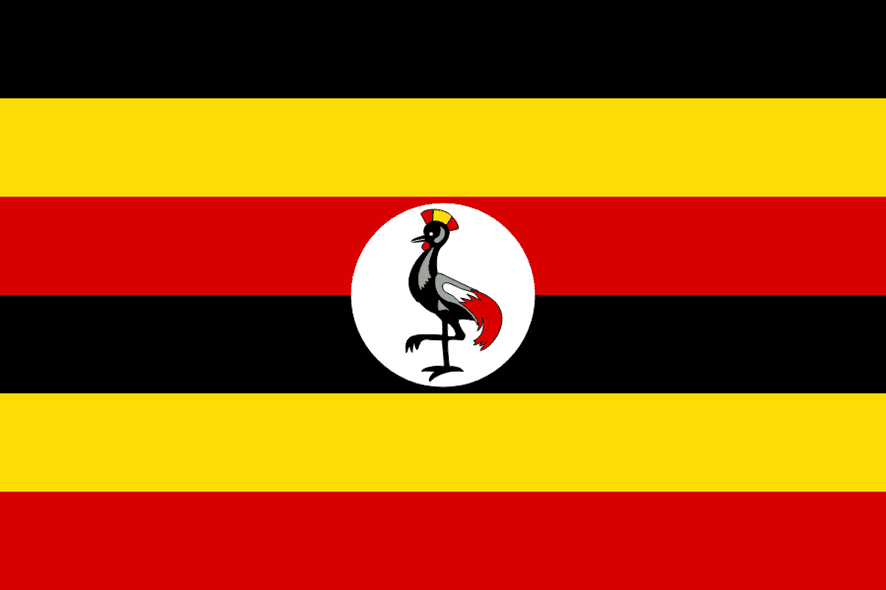
Hire in Uganda
Begin your journey into human resources best practices and recruitment in Uganda with the following steps.

Currency of Uganda
Ugandan Shilling (UGX)

The Capital of Uganda
Kampala
Time Zone in Uganda
GMT+3
Important Facts About the Country of Uganda
Introduction to Uganda
Uganda, formally known as the Republic of Uganda, is a landlocked East African country. With a population exceeding 49 million, approximately 8.5 million people call Kampala, its capital and largest city, home. The region was under British protectorate from 1894, leading to the establishment of administrative law across the territory. Uganda gained independence from the United Kingdom in 1962.
What to Know about Uganda’s Geography
Uganda covers an expansive area of around 240,000 square kilometers and is surrounded by Kenya to the east, South Sudan to the north, the Democratic Republic of the Congo to the west, Rwanda to the southwest, and Tanzania to the south. The terrain of the country is diverse, featuring volcanic hills, mountains, and lakes. Uganda, on average, rests at an altitude of 900 meters above sea level.
Climate in Uganda
The tropical climate of Uganda is shaped by its elevation and the existence of lakes. Positioned near the equator, Uganda experiences relatively consistent sun declination at midday, providing nearly 12 hours of daylight throughout the year. Adequate precipitation is typically observed across most regions of Uganda.
The Culture of Uganda
Ugandans lead diverse lifestyles and engage in a variety of interests, reflecting the cultural diversity of the nation. The country boasts a vibrant theatrical scene, encompassing the lively National Theatre in Kampala and numerous local theatrical groups. Additionally, small video booths, prevalent in towns and rural trading centers, serve as popular sources of entertainment.
Religions Observed in Uganda
Uganda exhibits three major religious traditions: indigenous religions, Islam, and Christianity. Christians make up approximately 80% of the population, with Roman Catholics and Protestants constituting the majority. Muslims account for about 12% of the population, while the remainder adheres to traditional religions.
Languages Spoken in Uganda
Uganda boasts a linguistic diversity with at least 32 spoken languages, but the most prevalent ones are English, Swahili, and Ganda. English serves as the official language for education and government, although proficiency is limited among the population. Swahili, chosen as the second official language for regional integration, is less widely spoken in Uganda compared to its neighboring countries.
Ugandan Human Resources at a Glance
Employment Law Protections in Uganda
The Employment Act of 2006 serves as the principal legislation governing employment relationships in Uganda. Complementary regulatory frameworks influencing labor relations encompass The Constitution of the Republic of Uganda, The Labor Unions Act, The Labor Disputes (Arbitrations and Settlement) Act, The Occupational Safety and Health Act, The National Social Security Fund Act, among others.
Employment Contracts in Uganda
Employment agreements may be verbal or documented. Nevertheless, an employer is obliged to furnish employees with a written statement of particulars within 12 weeks of commencing employment, outlining essential details such as:
- Complete names and addresses of the involved parties,
- initiation date of employment, designation,
- work location, along with details on wages, payment frequencies, and applicable deductions, including the overtime pay rate.
- Additionally, specifics on regular working hours, assigned shifts or workdays,
- annual leave entitlements, corresponding wages,
- terms related to sick leave or injury-related incapacity,
- the duration of notice required for employment termination.
The employer is obligated to present this information in a clear and easily comprehensible language.
In case of any changes to the employment contract, the employer is required to furnish written notification to the employee. Furthermore, the employer is expected to keep a copy of the written particulars and any modifications for potential submission to a labor officer upon request.
Uganda's Contract Terms
In Uganda, employment contracts offer flexibility, allowing for open-ended or fixed-term arrangements, as well as part-time or full-time engagements.
Fixed Term Contacts for Ugandan Employees
In Uganda, employers have the flexibility to extend permanent positions to contract workers without specific limitations on duration or renewal conditions. However, regulations apply to distinct categories of temporary workers, including casual workers, piece workers, and task workers.
Typically, temporary employment for these workers is capped at four months. If a casual employee maintains continuous employment for four months, they transition to regular employment status and gain entitlement to the same rights and benefits as other employees.
For piece-work employees without a formal contract, the maximum employment period is restricted to three months.
Pre-Employment Checks
In Uganda, employers commonly conduct pre-employment checks, including reference and background checks, as part of standard practices. However, specific regulations regarding these checks are not explicitly defined.
Uganda's Guidelines Regarding Probation Period/Trial Period
In Uganda, the probation period for employees typically lasts for a maximum of six months, although it can be extended to one year with the employee’s agreement. Employers or employees have the right to terminate the employment contract during this probation period, with a notice period of 14 days. Alternatively, the employer can opt to provide seven days’ wages in lieu of notice. It’s important to note that an employee cannot undergo probation twice with the same employer.
Regulations and Rules Regarding Working Hours in Uganda
In Uganda, employees typically adhere to a standard schedule of eight hours per day and 48 hours per week. Overtime work is permissible, but the total working hours should not exceed 10 hours per day or 56 hours per week, unless the employees are engaged in shift work.
Additionally, employees have the right to enjoy 24 consecutive hours of uninterrupted rest each week. This rest period can be observed on a customary rest day, usually on Sundays, or on a day mutually agreed upon by both the employer and the employee.
Ugandan Laws Regarding Overtime
If employees exceed the standard eight hours a day or 48 hours a week, they are entitled to compensation at a minimum rate of 1.5 times their regular hourly wage on weekdays. On public holidays, this compensation increases to two times their normal hourly rate.
Termination
In Uganda, employers are not permitted to terminate employees arbitrarily; valid reasons must exist for termination. A fair hearing or consultation process is required before termination, wherein the grounds for termination are communicated to the employee.
Unjustly terminated employees are entitled to basic compensation equivalent to four weeks’ salary. If an employer issues a notice of termination, the employee has the option to terminate the contract before the notice period concludes without being obligated to compensate the employer for the remaining duration.
Uganda's Requirements Regarding Notice Periods
The required notice period depends on the employee’s length of service as follows:
- Less than six months of service: No notice requirements.
- Service of more than six months but less than one year: Two weeks’ notice.
- Service of more than 12 months but less than five years: One month’s notice.
- Service of more than five years but less than 10 years: Two months’ notice.
- Service of 10 years or more: Three months’ notice.
Payment in lieu of notice is permissible; nevertheless, the employer must secure the employee’s agreement before providing the payment. If the employee does not agree, the employer must permit the employee to work until the conclusion of the notice period.
Redundancy/Severance Pay in Uganda
Employers are required to provide severance pay in the following circumstances:
- Instances of unjust termination
- In situations of the employer’s bankruptcy or demise leading to contract termination
- In the event of the employee’s demise while in the service of the employer
- If the employee concludes the contract due to physical incapacity
To be eligible for severance pay, the impacted employee must have fulfilled a minimum of six months of uninterrupted service. The specific severance pay amount is subject to negotiation between the employer and the employee or the labor union representing the employee.
Post-Termination Restraints/Restrictive Covenants
Limitations on employee activities, known as restrictive covenants, are allowable only in specific and justified situations. Typically, their duration does not extend beyond six to 12 months.
Data Protection
In Uganda, data protection is regulated by the Data Protection and Privacy Act of 2019. Employers are obligated to secure explicit consent from employees before collecting and processing their personal information.
Tax and Social Security Information for Employers in Uganda
Personal Income Tax in Uganda
In adherence to tax regulations in Uganda, employers are required to withhold, declare, and remit the Pay-As-You-Earn (PAYE) tax to the tax authority within 15 days following the conclusion of the month in which the tax obligation arose.
The following tax brackets apply to employment income for residents of Uganda:
| Monthly Taxable Income (UGX) | Tax |
|---|---|
| 0 – 235,000 | 0 |
| Exceeding 235,000 but not exceeding 335,000 | 10% on the amount exceeding 235,000 |
| Exceeding 335,000 but not exceeding 410,000 | 10,000 + 20% of the amount exceeding 335,000 |
| Exceeding 410,000 | 25,000 + 30% of the amount exceeding 410,000; 25,000 + 30% of the amount exceeding 410,000; And where the chargeable income of an individual exceeds 10,000,000, an additional 10% on the amount exceeding 10,000,000 |
Social Security in Uganda
As per the National Social Security Fund Act in Uganda, employers must make monthly contributions. The employer is responsible for contributing 10% of the employee’s salary, and the employee is required to contribute 5%. These contributions, with no specific minimum or maximum earnings for calculation, are deducted from the employee’s salary during each payment period.
The rates mentioned above provide a general reference. Actual charges may vary.
Important Information for Ugandan Employees
Salary Payment
Employers are required to promptly disburse wages to their employees. Those compensated on an hourly or daily basis should be paid at the conclusion of each day or week, respectively, whereas employees who earn biweekly or monthly wages must be paid at the end of each two-week period or month.
Payslip
Employers must issue written, detailed payslips to every employee, indicating the gross pay and detailing any deductions made, including the reasons for such deductions.
Annual Leave
Employees have a right to at least 21 days of paid vacation each year, accumulating at a pace of seven days for every four consecutive months worked. Employees cannot waive their vacation entitlement for financial compensation. Not taking vacation within a given year results in the loss of that year’s vacation rights.
Upon termination, employees are eligible for payment in lieu of any accrued but untaken vacation.
Sick Leave
Employees working a minimum of 16 hours weekly and with at least one month of continuous employment are eligible for full salary and benefits during the initial month of absence due to illness. Should an employee remain incapacitated by illness after two months, the employer has the right to terminate their contract.
For entitlement to sick leave pay, employees are required to inform their employer of their absence without delay and submit a medical certificate from a certified healthcare professional.
Compassionate & Bereavement Leave
Employees have the right to three days of paid bereavement leave per instance, with an annual limit of six days, in the event of the death of a family member or dependent relative.
Maternity & Parental Leave
Maternity Leave
Women in the workforce are granted 60 working days of paid maternity leave, with a requirement to give at least seven days’ written notification prior to commencing their leave and again before resuming work. In cases of pregnancy or childbirth complications, this leave may be lengthened by an additional 20 working days.
Paternity Leave
Fathers are eligible for four days of paid paternity leave annually, to be taken upon the birth of their child or in the event of their wife’s miscarriage.
Public Holidays
Uganda observes 15 public holidays. Employees mandated to work on these days are entitled to double their standard pay rate as compensation.
Benefits to the Employee in Uganda
Ugandan Statutory Benefits
Every employee has the right to public holidays, annual leave, sick leave, maternity leave, paternity leave, and compassionate leave. For those contributing to the National Social Security Fund (NSSF), five additional benefits are accessible:
- Age-related benefit,
- withdrawal benefit,
- invalidity benefit,
- emigration grant, and survivor’s benefit
- National Social Security Fund (NSSF).
Other Benefits
Employers in Uganda often provide additional employee benefits such as employment insurance and health insurance, which are typically managed by private service providers.
Rules Regarding Visas and Foreign Workers in Uganda
General Information
Individuals from foreign countries intending to work in Uganda, whether for paid employment or as volunteers, must secure a work permit. Selecting the right type of work permit is essential before initiating the application process. The following are the typical types of work permits for paid employment in Uganda:
- Class A and A2: Designed for government employees, diplomats, and government contractors.
- Class B: Intended for foreign nationals looking to invest in the agricultural industry.
- Class C: For foreign nationals planning to invest in the mining industry.
- Class D: Geared towards foreign nationals engaging in business or commerce in Uganda.
- Class E: Specifically for manufacturers intending to invest in or establish a manufacturing business in Uganda.
- Class F: Tailored for working professionals aiming to practice their profession in Uganda.
The validity period of work permits in Uganda ranges from six months to 36 months.
Public Holidays Recognized by Uganda in 2024
| Occasion | Date | |
|---|---|---|
| 1 | New Year’s Day | January 1 |
| 2 | NRM Liberation Day | January 26 |
| 3 | Archbishop Janani Luwum Day | February 16 |
| 4 | International Women’s Day | March 8 |
| 5 | Good Friday | March 29 |
| 6 | Easter Sunday | March 31 |
| 7 | Easter Monday | April 1 |
| 8 | Eid al-Fitr* | April 10 |
| 9 | Labor Day | May 1 |
| 10 | Martyrs’ Day | June 3 |
| 11 | National Heroes Day | June 9 |
| 12 | Eid al-Adha* | June 17 |
| 13 | Independence Day | October 9 |
| 14 | Christmas Day | December 25 |
| 15 | Boxing Day | December 26 |
* Religious holidays are confirmed closer to the date as they depend on the sighting of the moon.
Hire New Talent in Uganda
Our global hiring services enable you to onboard personnel in any country without the financial commitment required to establish a local entity.