

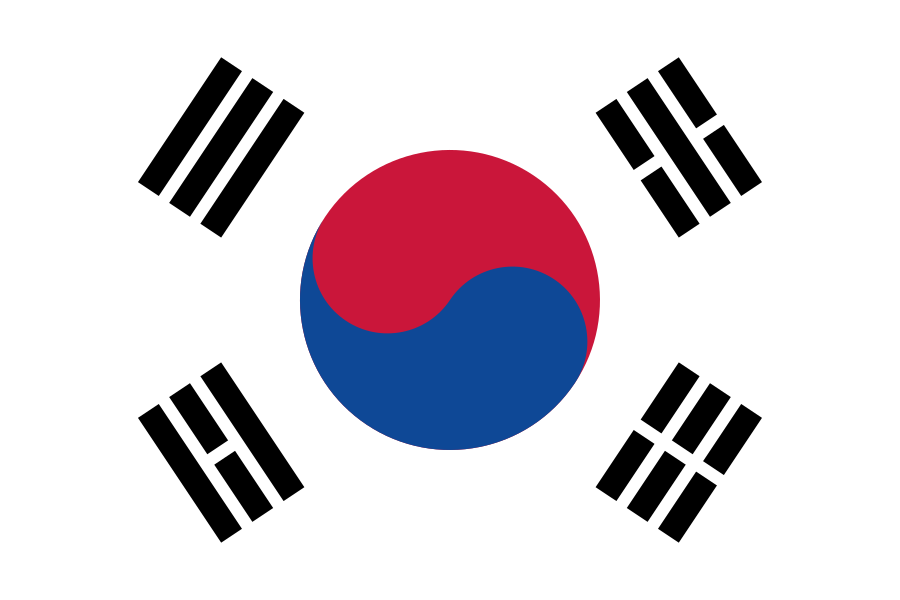
Hire in South Korea
Embark on your exploration of human resources best practices and recruitment in South Korea right here.

South Korean Currency
South Korean Won (KRW)

The Capital of South Korea
Seoul
Time Zone in South Korea
GMT+9
Important Facts About the Country of South Korea
Introduction to South Korea
After experiencing rapid economic growth for decades, South Korea has emerged as a high-tech, industrialized economy valued at $2 trillion. Key sectors driving this growth include electronics, telecommunications, automobile manufacturing, chemicals, shipbuilding, and steel production. Seoul, the capital of South Korea, boasts a population of over 25 million, representing approximately 50% of the country’s total population. South Korea operates under a civil law system, with its legal framework based on the Constitution of the Republic of Korea.
What to Know about South Korea’s Geography
South Korea occupies the southern portion of the Korean Peninsula, spanning approximately 99,720 square kilometers. It is bordered by the East Sea and the Yellow Sea.
Climate in South Korea
South Korea experiences a temperate climate characterized by four distinct seasons. Winters are cold, dry, and prolonged, while summers are typically short, hot, and humid, accompanied by significant rainfall.
The Culture of South Korea
Situated in the heart of Northeast Asia, South Korea boasts a culture that embodies the essence of Asia, featuring a diverse blend of multicultural influences. The society is characterized by peaceful coexistence and harmony among its people. Koreans are known for their warmth and friendliness, readily welcoming foreigners into their social circles.
Religions Observed in South Korea
Approximately 46% of South Korea’s population identifies as having no religious affiliation, while 23% adhere to Buddhism and 29% identify as Christian.
Languages Spoken in South Korea
Korean is the official language of South Korea, and Hangul is the official alphabet used for writing.
South Korean Human Resources at a Glance
Employment Law Protections in South Korea
The Labor Standards Act (LSA) serves as the primary legislation governing the employment relationship in South Korea, establishing minimum employment standards. The country’s labor environment is known for its employee-friendly policies, characterized by stringent employment protection laws.
Employment Contracts in South Korea
Employers in South Korea are obligated to furnish employees with written documentation outlining key terms related to wages, working hours, annual paid leave, and weekly holidays upon entering into an employment contract. These written terms must be provided to the employee at the commencement of their employment, and the employer must retain a copy for at least three years following the termination of the contract. While contracts do not necessarily need to be in Korean, verbal or implied agreements are enforceable provided the existence of an employee-employer relationship can be established.
South Korea's Contract Terms
- Certain statutes, particularly the Labor Standards Act (LSA), impose limitations on the terms of employment contracts. Additionally, conditions outlined in the Rules of Employment (ROE) or a Collective Bargaining Agreement (CBA) may supersede the terms of the contract.
- Employees in South Korea can be employed on either a permanent basis or on a fixed-term basis, with fixed-term contracts typically limited to a duration of two years.
- The minimum retirement age in South Korea is 60 years old.
Work Rules
Companies with 10 or more employees in South Korea are required to prepare the Rules of Employment (ROE) document, which outlines various aspects of the employment relationship. This includes details such as wage calculation, payment schedule, method of payment, working hours, paid leave, training, maternity care, workplace health and safety, disciplinary procedures, and other working conditions. The ROE must be filed with the Ministry of Employment and Labor and made readily accessible to employees.
South Korea's Guidelines Regarding Probation Period/Trial Period
The probation period is discretionary and there is no fixed minimum in South Korea. A three-month period is common and it can be extended.
South Korean Laws Regarding Overtime
In South Korea, any work exceeding 40 hours per week or 8 hours per day is classified as overtime. However, employees are legally restricted from working more than 52 hours per week, inclusive of overtime hours. This means that the maximum allowable overtime hours per week is capped at 12 hours.
Employers are required to compensate employees for overtime, night work (defined as work conducted between 10 p.m. and 6 a.m.), or work performed on holidays. The compensation should amount to at least 50% or more of the employee’s ordinary wages for these additional hours worked. This ensures that employees are fairly compensated for their extra time and effort beyond regular working hours.
Rules Regarding Bonus and 13th Month Pay in South Korea
In South Korea, any work beyond 40 hours per week or 8 hours per day qualifies as overtime. However, employees are limited to working no more than 52 hours per week, which includes any overtime hours. This effectively sets the maximum overtime hours allowed by law at 12 hours per week.
Furthermore, employers are obligated to compensate employees for overtime work, night shifts (between 10 p.m. and 6 a.m.), and work performed on holidays. This compensation should amount to at least 50% or more of the employee’s ordinary wages, ensuring fair remuneration for additional work done outside regular hours.
Rules Regarding Bonus and 13th Month Pay in South Korea
In South Korea, there are no specific regulations or guidelines governing bonus payments. Bonus pay, which encompasses additional compensation for various factors such as overtime and professional achievements, is typically not integrated into regular monthly salaries. Instead, it is factored into the severance pay disbursed to employees upon the termination of their contracts.
To calculate bonus pay, the total amount due for one year is divided by 12 to represent the months in a year. This monthly bonus pay is then combined with the severance pay owed for one year. The resulting sum, comprising both severance and bonus pay, is then multiplied by the number of years the employee has worked at the company to determine the total compensation.
Termination
Terminating employment in South Korea can be challenging and requires valid reasons. Employers are required to provide written notice of dismissal to employees.
Typically, employees with over one year of tenure are entitled to severance benefits as outlined by law in cases of termination, regardless of the reason for termination.
Severance Pay in South Korea
Under the Employee Retirement Benefit Security Act (Retirement Benefit Act), employers in South Korea are required to take one of the following actions:
1. Provide severance payment upon the termination of employment.
2. Establish a retirement pension system with the consent of the employees.
Severance pay for an employee who has completed at least one year of service amounts to 30 days’ average wages for each year of continuous employment. Average wages are calculated based on the employee’s earnings in the three months preceding termination. This severance payment applies to both voluntary retirement and termination for cause.
If an employer fails to decide on a mandatory retirement package upon establishing a company, the retirement pay system is automatically adopted. In common language, “severance pay” and “retirement pay” are often used interchangeably in this context.
Under the Employee Retirement Benefit Security Act, employers and employees can opt for a retirement pension system instead of severance pay. To choose a retirement benefit system, employers must obtain agreement from a majority union or, in the absence of a majority union, from the majority of workers. The available options for retirement pension include defined contribution (DC) and defined benefit (DB) plans.
South Korea's Requirements Regarding Notice Periods
In South Korea, employers are required to provide a 30-day advance notice of termination to employees, or alternatively, pay them 30 days’ worth of wages in lieu of notice. However, this notice requirement may be waived if the employee is serving a probationary period of three months or less.
Employing People with Disabilities
Private enterprises in South Korea with more than 100 employees are legally obligated to ensure that at least 3.1% of their workforce comprises disabled persons. Failure to meet this quota requires employers to pay a contributory charge each year. The charge amount is determined based on the extent to which the employer falls short of the threshold and the national minimum wage.
Tax and Social Security Information for Employers in South Korea
Personal Income Tax in South Korea
Every individual subject to taxation in South Korea must declare their income to the National Tax Service (NTS).
Resident:
Residents of South Korea are subject to income tax on all incomes derived from sources both within and outside South Korea. Foreign residents who have stayed in Korea for longer than five years during the last 10-year period are taxed on their worldwide income. However, foreign residents who have stayed in South Korea for five years or less during the last 10-year period are taxed only on South Korea-source income. Foreign-source income is reportable only if it is paid by a South Korean entity or transferred to South Korea.
Non-resident:
Non-residents are subject to income tax only on income derived from sources within South Korea. When a non-resident without a domestic place of business has Korea-source income to report through an annual tax return, they will be subject to most provisions concerning the tax rates and the filing procedures of residents. However, in calculating taxable income and tax amount, a non-resident is not entitled to claim any personal exemptions for their dependents (except for themselves), income deductions, and tax credits.
These are the basic Personal Income Tax (PIT) rates:
| Income Above (Column A) | Income Not Above | Tax on (Column A) in KRW | Tax on Excess (%) |
|---|---|---|---|
| 0 | 14,000 | 0 | 6 |
| 14,000 | 50,000 | 840 | 15 |
| 50,000 | 88,000 | 6,240 | 24 |
| 88,000 | 150,000 | 15,360 | 35 |
| 150,000 | 300,000 | 37,060 | 38 |
| 300,000 | 500,000 | 94,060 | 40 |
| 500,000 | 1,000,000 | 174,060 | 42 |
| 1,000,000 | 384,060 | 45 |
Resident Surtax:
In addition to the personal income tax (PIT) collected by the National Tax Service (NTS), there is also a local income tax assessed at a rate of 10% of the PIT rates. The PIT is paid to the NTS, while the local income tax is paid to the city or province where the taxpayer resides.
Non-Taxable Items & Deductions
The following items are considered to be either non-taxable reimbursements or tax-exempt earned income:
Here are some common fringe benefits provided by employers in South Korea:
1. Meal allowance: Up to KRW 200,000 per month.
2. Reimbursement of vehicle operating expenses: Up to KRW 200,000 per month for business use of employee-owned vehicles.
3. Childcare allowance: Up to KRW 200,000 per month for employees with children aged six years and under.
4. Cost of uniforms: Provided to employees required by law to wear uniforms.
5. Work clothes: Cost of work clothes exclusively worn at the workplace by employees in specified industries.
6. Social membership and entertainment expenses: Reimbursement for business-related social and entertainment expenses.
7. Education fees: Employer-paid education fees for qualified employees.
8. Housing costs: Cost of housing for expatriate employees, paid directly by the employer if the rental contract is between the employer and the landlord.
9. Insurance premiums: Premiums for Group Genuine Indemnity Insurance and Group Refund-cum-guaranty Insurance, up to KRW 700,000 per year.
Deductions for all taxpayers in South Korea can include the following, with specific conditions applicable for each:
Here are some deductions and allowances available to taxpayers in South Korea, along with applicable conditions:
1. Automobile Allowance: Taxpayers may be eligible to deduct automobile-related expenses, such as fuel and maintenance costs, up to a certain limit.
2. Meal Allowance: Deductions are available for meal expenses incurred for business purposes, subject to specific conditions and limitations.
3. Employer-Paid Insurance Premiums: Insurance premiums paid by the employer on behalf of the employee may be deductible, depending on the type of insurance and the coverage provided.
4. Medical Expenses: Taxpayers can deduct medical expenses, including payments for medical treatment, prescriptions, and hospital visits. Receipts must be submitted as proof.
5. Payments via Credit Card or Designated Cash Receipts: Taxpayers may be eligible for deductions for certain payments made using credit cards or designated cash receipts, with rebates provided under specific conditions.
6. Charitable Donations: Deductions are available for donations made to eligible charitable organizations, both domestic and some foreign entities.
7. Education Expenses: Deductions are allowed for expenses related to education, including tuition fees and educational materials, for dependents’ kindergarten through university, and for self-education, such as graduate studies.
8. Dependent Deduction: Taxpayers can claim deductions for themselves, their spouse, and dependent family members, with the amount of deduction for dependents being age-related.
These deductions and allowances are subject to change based on tax laws and regulations. Taxpayers should consult with tax professionals or relevant authorities for the most accurate and up-to-date information regarding deductions and eligibility criteria.
PIT: Employer Requirements
Employers in South Korea have specific obligations regarding tax settlement and reporting for their employees:
1. Tax Settlement Documents Submission: Employers must submit tax settlement documents on behalf of their employees by March 10 each year. Employees are typically asked to provide necessary documents and information in January. During this time, foreign employees can choose between paying the flat 19% tax rate or using the progressive rate based on their income.
2. Monthly Reporting: Employers are required to report each employee’s income and withholdings from the previous month by the 10th day of each month. For instance, the report for January’s income and withholdings must be submitted by February 10.
3. Annual Reconciliation: The annual reconciliation for the previous tax year is conducted in January, with reports due by February 10. This process ensures accuracy and compliance with tax regulations.
4. Wage & Salary Income Taxes Withholding Receipt Form: Employers must provide employees with a Wage & Salary Income Taxes Withholding receipt form every February.
5. Resident Tax: If the monthly average total salary of employees at the workplace exceeds 150 million won (calculated as 3 million won multiplied by 50), resident tax becomes payable. This additional employment cost is calculated at 0.5% of the total salary minus non-taxable income, regardless of the number of employees.
Employers play a crucial role in facilitating tax compliance and ensuring accurate reporting for their employees in South Korea.
Social Security in South Korea
In South Korea, there are four compulsory social insurance schemes outlined by law:
1. National Pension Insurance: Employers must enroll all employees, including the company’s representative director, in the National Pension Scheme. Contributions are shared equally between employers and employees, amounting to 9% of monthly employment income, with each party contributing 4.5% of monthly income up to KRW 5.90 million.
2. National Health Insurance: Employers are required to register all employees, including the company’s representative director, with the National Health Insurance. Contributions are computed as 7.09% of monthly employment income, with both employers and employees equally sharing the contribution burden.
3. Employment Insurance: All employees, except representative directors, must be enrolled in the Employment Insurance scheme. Both employers and employees contribute to this insurance, with a 0.9% contribution rate for unemployment benefits. Employers also pay additional contributions ranging from 0.25% to 0.85% of monthly employment income for employment stability and vocational competency development.
4. Industrial Accident Compensation Insurance: Employers are solely responsible for paying the insurance contributions on behalf of their employees. Contribution rates vary by industry, with rates ranging from 0.73% to 2.53% for manufacturing companies, 0.9% for wholesale or retail businesses, and 0.73% for enterprises in financial services and insurance. There is no income ceiling for this insurance.
These social insurance schemes provide coverage for various aspects of employee welfare, including pension, health care, unemployment benefits, and compensation for industrial accidents, ensuring comprehensive protection for employees in South Korea.
| Social Security System | Monthly Salary Cap (KRW) | Employer Contribution (%) | Employee Contribution (%) |
|---|---|---|---|
| National Health Insurance | 110,332,300 | 3.545 | 3.545 |
| Long Term Care | 110,332,300 | 0.455 | 0.455 |
| National Pension Insurance | 5,900,000 | 4.50 | 4.50 |
| Employment Insurance | – | 1.15 | 0.90 |
| Worker’s Compensation Insurance* | – | 0.76 | 0.00 |
| TOTAL | 10.41 | 9.4 |
The rates mentioned above provide a general framework. However, the actual rates charged by GoGlobal may vary.
South Korean Social Security System Meaning & Benefits
Health Insurance:
- Aims to improve public health and promote social security by providing insurance benefits for preventing, diagnosing, treating, and rehabilitating from disease or injury.
- Service benefits include healthcare benefits and health checkups.
- Cash benefits cover care expenses, co-payment ceiling system, compensation for excessive co-payment, assistive device expenses for the disabled, and expenses for pregnancy and childbirth examinations.
National Pension:
- Aimed at contributing to people’s life stabilization and welfare promotion through the implementation of public pension benefits for geriatric disease or death.
- Pension benefits include old-age pension, disability pension, and survivor’s pension.
- Lump-sum allowance covers pension refund and death benefit.
Industrial Accident Compensation Insurance:
- Aims to compensate workers for industrial accidents rapidly and fairly.
- Operates insurance facilities required for promoting the worker’s rehabilitation and return to society.
- Promotes worker safety through disaster prevention businesses.
- Benefits include care benefit, temporary incapacity benefit, disability benefit, nursing benefit, survivor benefit, funeral expenses, injury and disease compensation pension.
Employment Insurance:
- Aims to prevent unemployment and promote employment.
- Enhances worker’s vocational competency development.
- Provides occupational guidance and introduction services.
- Promotes the life stabilization of unemployed workers through benefits for livelihood.
- Includes stable employment business, vocational competency development business, and unemployment benefit.
Retirement Pension Plans
All employers, with the exception of those employing relatives living together, are mandated to establish either a defined benefit (DB) plan, defined contribution (DC) plan, or Severance Pay System. However, this obligation does not extend to employees with less than one year of service or temporary workers who perform less than 15 hours of work per week on average for the most recent four weeks.
Under the Severance Pay System, unlike retirement pension plans, employers are not obligated to make external cash contributions. Therefore, the authority strongly encourages employers to opt for one of the retirement pension plans. Consequently, accrued severance pay expense in the profit and loss account is not tax-deductible from 2016 onwards.
The government plans to gradually eliminate the severance pay system and encourage retirement pension plans for all employers.
Types of retirement pension plans:
Defined Benefit (DB) Plan: ERBSA mandates that upon termination of employment, an employee’s retirement entitlements should be no less than 30 days’ worth of average salary per year of service. Moreover, employers must contribute to the DB Plan, with contributions equal to or exceeding a prescribed percentage (e.g., 80% from 2016 to 2017) of an employee’s statutory retirement benefit entitlement.
Defined Contribution (DC) Plan: Employers who adopt a DC Plan are obligated to make periodic contributions equivalent to one-twelfth of an employee’s annual salary to the DC Plan. Notably, 100% of these contributions to the DC Plan are tax-deductible for the employer. Unlike a DB Plan, employees enrolled in a DC Plan have the option to make additional contributions to their pension plan.
Individual Retirement Pension (IRP) Plan: Employees have the option to establish IRPs to manage their retirement benefits provided by their employers. Employers cannot establish IRPs for their employees, but they are required to transfer existing retirement benefits to the employee’s IRP within the prescribed deadline after termination of employment. It’s important to note that employees can contribute a maximum amount of KRW 18 million per year to their personal type IRP, in addition to the retirement benefits paid by the employers.
Important Information for South Korean Employees
Salary Payment
Salaries are typically disbursed on a monthly basis in South Korea, with payments made via bank transfer directly to the employee’s designated bank account.
Payslip
Employers in South Korea are mandated to provide payslips to workers when disbursing wages. Workers must have access to the payslip via website, PDF, or hard copy format. The payslip should contain the following details: employee name, employee number, payday, number of working days, total wage, total number of working hours, number of overtime hours, amount for each wage item, calculation method for each wage item, deduction items, and the final effective amount paid to the employee.
Annual Leave
- Companies in South Korea are required to provide paid leave to employees, with a minimum of 15 days per year.
- Employees who have worked for 80% of the total working days in the first year are entitled to use 11 days of annual leave within that year.
- For employees with less than 80% attendance, the number of leave days for the following year is based on one leave day for each full working month in the previous year.
- The number of leave days increases every two years from the fourth year onward, reaching a maximum of 25 days.
- If an employee does not utilize all of their annual leave within a year, the unused days will not carry over to the following year and will expire. However, the employer is required to compensate the employee with wages for the unused leave. If the employer provides written notice to the employee, urging them to utilize the remaining leave days by the end of the year, the employer may be exempt from compensating the employee for the unused annual leave if the employee does not comply.
- Some foreign companies in South Korea permit the carryover of annual leave from one year to the next. This practice is permissible because the Labor Standards Act (LSA), as the minimum standard, does not forbid employers from implementing working conditions that exceed the requirements of the law.
Sick Leave
- Employees in South Korea are not legally entitled to sick leave for non-work-related illnesses or injuries.
- However, many companies in South Korea offer sick leave to their employees as a special benefit. This allowance typically includes several months of unpaid leave or several weeks of paid leave if the illness or injury requires it.
- Regarding work-related illnesses or injuries, worker’s compensation insurance in South Korea covers partially paid leave and pays for treatment, as well as providing additional compensation for any lasting disability.
Pregnancy
Pregnant female employees who are at medical risk of miscarriage or stillbirth are entitled to use childcare leave while still pregnant in South Korea. They can also request to change their working start and end times while maintaining the prescribed number of working hours. However, the employer can only refuse such requests for reasons prescribed by regulations, such as if the proposed hours would disrupt the normal operations of the business.
Maternity & Parental Leave
Employers in South Korea are required to provide 90 days of maternity leave (or 120 days in the case of twins). During the first 60 days (or 75 days for twins), maternity leave is paid by the employer, with the government providing a subsidy of up to KRW 2,000,000 per month.
For the remaining 30 days (or 45 days for twins), the government pays, also capped at KRW 2,000,000 per month. At least 45 days of leave (or 60 days for twins) must be taken after the birth.
Maternity paid leave is applicable for miscarriages and premature births as follows:
- 5 days for pregnancies lasting up to the 11th week,
- 10 days for those in the 12th to 15th week of pregnancy,
- 30 days for those in the 16th to 21st week of pregnancy,
- 60 days for those in the 22nd to 27th week of pregnancy,
- The full 90 days for pregnancies lasting at least 28 weeks.
Employers must also grant at least ten days of paid paternity leave upon request, which must be made within 90 days of childbirth. Additionally, women with infants under the age of one are entitled to at least 30 minutes of nursing time, twice a day.
Child Care Leave
Employers in South Korea are obligated to grant childcare leave to eligible employees upon request. This leave can last up to one year (with a minimum of 30 days) for an employee who has a child aged eight or younger or who is in the second grade of elementary school or under, including adopted children.
Both parents, if eligible, can take childcare leave for the same child simultaneously or sequentially within 12 months of the child’s birth. The government provides compensation through Employment Insurance Funds at 80% of the ordinary wage for the first three months, with monthly payments ranging from KRW 700,000 to KRW 1.5 million.
Additionally, there are special cases:
1. 3+3 Parental Leave System: Parents taking childcare leave simultaneously or sequentially within 12 months of the child’s birth may receive increased childcare leave pay for the first three months.
2. Single-Parent Worker Childcare Leave Pay Special Case: Single-parent workers may receive 100% of the normal wage for the first three months (up to KRW 2.5 million) and 80% of the normal wage for 4 to 12 months (up to KRW 1.5 million).
Employers must allow workers to apply for childcare leave if they meet the requirements and must return the worker to the same job or a job with the same pay level after the leave. However, employers are not legally required to pay wages during childcare leave.
Family Care Leave
Employers in South Korea are required to offer family care leave, which can range from 30 to 90 days per year, to employees who need to care for sick, injured, or elderly family members. Eligible family members include parents, spouses, children, and a spouse’s parent.
Family care leave is unpaid, but the duration of this leave is considered part of the employee’s continuous service. This means that the period during which an employee takes family care leave will still count towards their total length of employment with the company.
Other Leave
In addition to other types of leave, female employees in South Korea are typically entitled to one day of unpaid leave each month for menstruation. This provision acknowledges the unique needs of female employees and allows them time to manage menstrual-related issues without facing financial repercussions.
Furthermore, it’s common for employers to grant leave for significant life events such as marriage or the death of a relative. These additional leaves demonstrate employer flexibility and support for their employees during important personal milestones or periods of grieving.
Public Holidays
In South Korea, mandatory paid holidays include weekly holidays, typically on Sundays, as well as Labor Day on May 1st, and public holidays. Employees who work on holidays are entitled to receive 50% additional pay.
South Korea also employs an alternative holiday system, wherein the first weekday following a public holiday that falls on a weekend is designated as a substitute holiday. This ensures that employees still receive time off in lieu of holidays that occur on weekends.
Medical Checks
According to Article 25 of the Enforcement Decree of the National Health Insurance Act, health check-ups must be conducted at least once every two years. However, for employers not involved in office work, health check-ups must be conducted annually. These check-ups must be carried out at an institution designated in accordance with Article 14.
Benefits to the Employee in South Korea
South Korean Statutory Benefits
Pension
In South Korea, employer-sponsored retirement plans serve as supplements to the pay-as-you-go National Pension Scheme, which forms the basic social security safety net covering old-age, survivors, and disability benefits. Initially introduced in 1961, these plans were mandatory for companies with 30 or more employees, providing lump-sum severance payments of at least one-month average pay per year of service. Over time, coverage expanded to include employers with five or more employees.
Under the 2005 Employee Benefit Retirement Security Act, employers are encouraged to adopt tax-advantaged retirement plans, such as defined benefit or defined contribution plans. They may also convert existing mandatory severance plans, subject to employee consent. Additionally, employers with fewer than ten employees have the option to make tax-free contributions to individual retirement accounts on behalf of their employees.
Rules Regarding Visas and Foreign Workers in South Korea
General Information
Pension
The following special income tax rules are available to expatriates in South Korea:
Foreigners have the option to choose between two methods for calculating their employment income tax:
1. Apply a flat tax rate of 19% to their total Korea-sourced employment income. No deductions or credits are allowed under this method.
2. Use the regular method of tax calculation, which involves applying graduated tax rates ranging from 6% to 42% to adjusted taxable income. This adjusted income is derived by subtracting applicable deductions and exemptions from gross income. The tax amount calculated using this method is further reduced by applicable tax credits to determine the final tax due amount.
To select the 19% flat rate, taxpayers must file an application during the monthly payroll withholding tax return, year-end payroll tax reconciliation, or when filing the annual composite income tax return.
The monthly payroll withholding tax return is due on the 10th day of the following month. Year-end tax reconciliation is due on March 10, and the annual composite income tax return is due on May 31 of the year following the tax year.
Public Holidays Recognized by South Korea in 2024
| Occasion | Date | |
|---|---|---|
| 1 | New Year’s Day | January 1 |
| 2 | Seollal | February 9 – 11 |
| 3 | Substitute Holiday for Seollal | February 12 |
| 4 | March First Movement Day | March 1 |
| 5 | 22nd National Assembly Election Day | April 10 |
| 6 | Labour Day* | May 1 |
| 7 | Children’s Day | May 5 |
| 8 | Substitute Holiday for Children’s Day | May 6 |
| 9 | Buddha’s Birthday | May 15 |
| 10 | Memorial Day | June 6 |
| 11 | Liberation Day | August 15 |
| 12 | Chuseok | September 16 – 18 |
| 13 | National Foundation Day | October 3 |
| 14 | Hangeul Day | October 9 |
| 15 | Christmas Day | December 25 |
* Not a public holiday but is a mandatory paid holiday.
Hire New Talent in South Korea
Our global hiring services enable you to onboard personnel in any country without the financial commitment required to establish a local entity.